
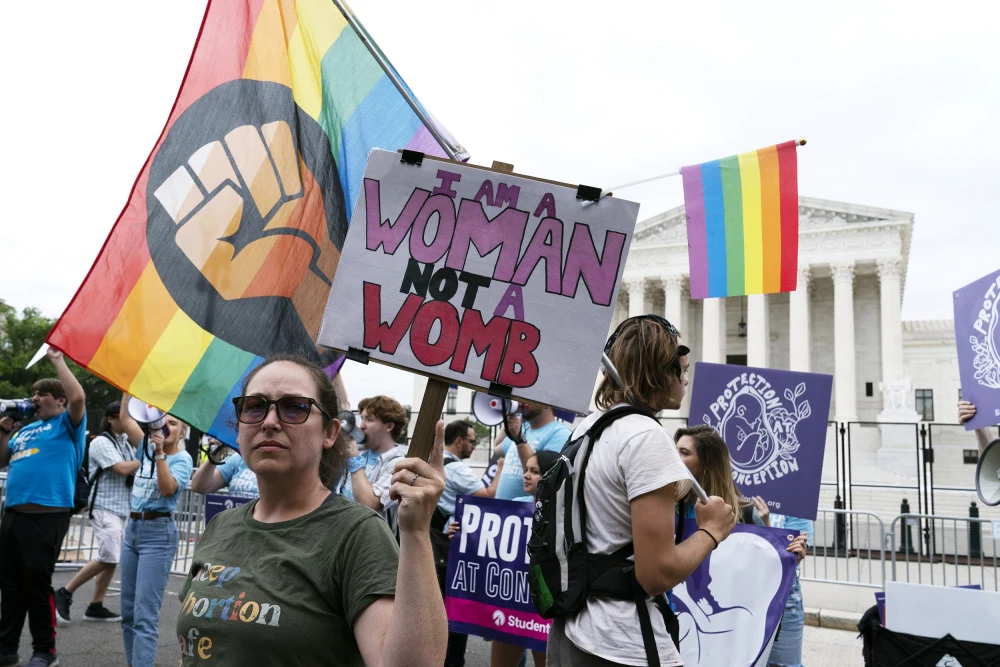
Photo by Jose Luis Magana/AP.
The Centers for Disease Control and Prevention’s (CDC) page for Sexual Health Education daunts the following message: “The Trump Administration rejects gender ideology due to the harms and divisiveness it causes. This page does not reflect reality and therefore the Administration and this Department reject it.”
The rhetoric employed by the current administration surrounding sex and sexual health indicates a hard pivot toward the political right that threatens the attainability of healthcare for women, queer people, and racial minorities. This language can be traced back to 1990s purity culture, which is foundational to the strategy and legislative assaults against sexual education and health resources initiated by the current administration.
The war on pleasure stems from evangelical purity culture and is aimed at silencing the conversations surrounding sex. The attack on sex, and more specifically female pleasure, finds its roots in the Christian right which is traditionally conservative.
Traditional conservatism idolizes virginity, condemns sex, and utilizes a patriarchal social structure to permeate these goals. This structure is institutionalized by codifying gender roles to meet heteronormative standards for sex and relationships. Since Trump started his second term, he has pushed an aggressive agenda to achieve these goals by defunding critical sexual health and education programs. The legislative decisions and rhetoric used by the first and second Trump administrations perpetuate purity culture, and indicate a future in which public health and educational institutions are subjected to the political preferences of the administration as not to risk funding cuts.
The first anti-sex campaigner was Anthony Comstock, who lobbied for the ban of contraceptives in the late 1800s. Comstock dedicated his career to upholding sexual morality through legislation, and his legacy is revered by modern day conservatives. Comstock positioned his platform in a light that appealed to conservative Christians, and it was with this appeal that he was able to garner support for his legislative goals.
However, Comstock’s legislative victories and ideals began to deteriorate with the rise of second wave feminism. In the 1960s, second wave feminism– also called the Women’s Liberation Movement– exploded across the country, marking an era in which women gained substantially more decision-making power over their reproductive health. The reason for this change? The invention of the pill. The birth control pill is an oral contraceptive that gives women full control over their fertility. This new technology pushed many women to recognize sex as a reproductive right.
The activism of the 60s served as an incubation period to the landmark decision in Roe v. Wade (1973), which established abortion protections through a viability framework. At the same time, the Gay Liberation Movement (1969-1980) underwent a parallel development as queer people demanded equal access to healthcare. Consequently, sex took on a representative role for many marginalized communities.
Two decades later, in the 1990s, purity culture was born. Purity culture is a movement that stems from Evangelical Christian teachings that emphasize moral guidelines relating to sex and scandals. Central to purity culture is the practice of abstinence as a means of avoiding sexual impurity. Within this system chastity is rewarded and sex is punished.
In 1994, the purity culture movement climaxed. On July 29th, 1994 hundreds of thousands of teenagers gathered in Washington D.C. to sign virginity pledge cards in a symbolic effort to demonstrate their commitment to abstinence. The event was coordinated by the Southern Baptist organization True Love Waits, and is often considered the culmination of the evangelical purity movement. True Love Waits took off. Abstinence pledges were signed across the country, and by 2005 the government was spending $170 million a year on abstinence education.
Because they blur religion and science, abstinence curriculums are notoriously misleading. A report by the House of Representatives Committee on Government Reform (2004) found that over 80% of abstinence curricula (funded by the government) contained false or inaccurate information about reproductive health. In conjunction with the fact that abstinence curricula are unreliable, a study from 2000 found that the virginity pledgers are more likely to engage in unsafe sex than nonpledgers, demonstrating that abstinence does not assure efficacy. Displayed below: Figure 1 shows that states with a high abstinence education level experience higher rates of teen pregnancy, contradicting the conservative narrative that abstinence-only education is more effective than comprehensive sexual education programs.

Guilt and shame are closely associated with sex, inhibiting individual confidence as well as the potential of forming meaningful and healthy sexual relationships. Purity culture not only teaches young girls to abstain from sex, but it conditions them to respond negatively to sexual expression and promiscuity. As a result, conversations about pleasure become uncomfortable. Women’s sexual needs are stigmatized, and pursuing pleasure– as a woman– risks pushing the line of radicalism. There is a heavy stigma surrounding conversations about sex that is enabling conservatives to wield silence as a political weapon against women.
By stigmatizing sex and discouraging conversations about pleasure, purity culture poses a threat to the mental and sexual health of people. A study conducted in 2019 found that virgin women aged 19 and over are likely to experience mental distress as the stigma surrounding virginity pressures them to remain virgins, which not only hinders their comfort talking about sex, but also impairs their ability to develop intimate relationships with others.
Tangentially, conversations about female pleasure are treated as a challenge to heteronormative relationships as purity culture preaches that a woman’s sexual needs are inferior to those of a man.

Since 2016 the Trump administration has acted as an avenue for the war on pleasure, with MAGA spearheading the campaign against sex. The war on pleasure empowers conservatism and institutionalizes these values with policy changes. Figure 2 indicates a correlation between the first Trump administration and an increase in federal funding for abstinence-only programs as opposed to comprehensive sexual education programs.
Major legislative actions taken since 2016, such as the decision made in Dobbs v. Jackson Women’s Health Organization (2022), demonstrates that social movements have little hold against hard law.
In April 2025, massive cuts were made to DOJ funding. An estimated initial cut amount rests at $819.7 million. These legislative decisions exacerbate existing systemic disadvantages, further suffocating the autonomy of women, people of color, and queer people.
Purity culture has penetrated education with funding cuts for schools that fail to meet content standards in sexual education. Content standards set by the Trump administration enforce heteronormative standards and aim to prevent gender indoctrination by regulating the rhetoric used in schools. The objective of this strategy is to silence the discussions surrounding sex by propagating abstinence.
This past June (2025) the ACF defunded California’s Personal Responsibility Education Program (PREP) grant, which provides state schools with $12 million for sexual education. California is the first state to face legal consequences for refusing to comply with Trump’s content standards, which are articulated by Project 2025. The cut was made because of the state’s noncompliance to remove gendered ideology from their curriculum. Gendered ideology refers to materials intended to support transgender youth. By weaponizing funding cuts as a means of punishing states for not adhering to conservative values, comprehensive sex education is being subordinated to heteronormative preferences.
On August 26th, 2025, the Administration for Children & Families (ACF) officially informed 46 states and territories that their eligibility for PREP funding rests on their compliance to remove gender ideology from offered materials.
The education gap left in the wake of defunding PREP (depending on state compliance or noncompliance) threatens the sexual health and decision-making abilities of young adults across the country. PREP uses evidence-based programs, and youth that have graduated the PREP program have demonstrated strong understandings of what constitute healthy sexual decisions. In a 2023 report, PREP reported that following their program “65% of youth were more likely to use condoms if having sex”, “59% of youth were more likely to use birth control other than condoms if having sex”, and “more than three-quarters of youth said they were more likely to better understand what makes a relationship health (77 percent)”.
One of the key objectives of the sexual and gay liberation movements of the 1960s and 1970s was to foster greater fluency surrounding what LGBTQIA+ rights and identities look like. The sexual health needs of LGBTQIA+ people are vastly different from those of heterosexual cisgender people. By preventing young people from having these conversations, conservatives are empowered to continue advancing restrictive policies that further harm marginalized communities.
It is clear that the conservative war on pleasure is a political attack on women’s rights, rooted in purity culture and reinforced by recent policy changes. Following this examination of new legislation and rhetoric, it is evident that we are experiencing an age of suppressed sexual liberty. Resistance in the form of education is necessary to combat the attack on pleasure that so intently is wielded against women, queer people, and racial minorities.
• • •
Yuliana Rossi is a sophomore, studying Political Science, Security, and Technology. She is also involved with the Pre-Law Society and Delta Gamma.




Leave a Reply