
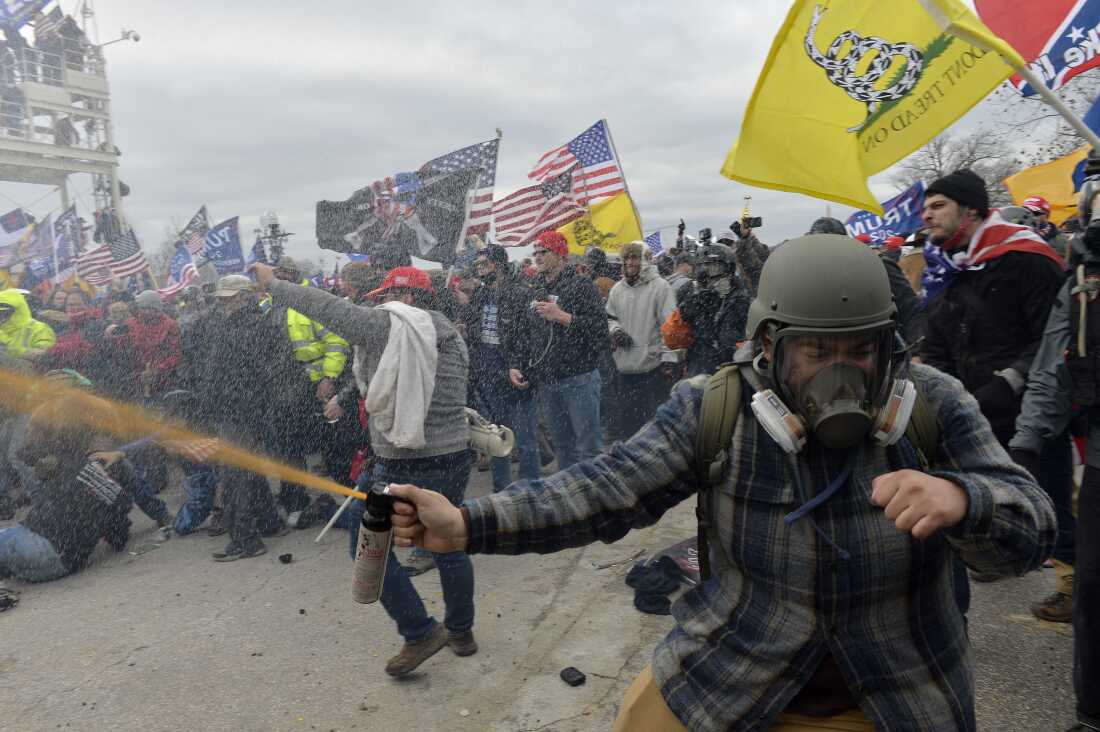
Photo from Joseph Prezioso/AFP via Getty Image.
Despite decades of counterterrorism efforts focused on foreign threats, domestic extremism here in the United States has often been overlooked. Domestic terrorism has increased by 37% in the United States between 2013 and 2021. The largest category of these attacks are classified as racially-motivated, rooted in far-right ideologies and the Great Replacement theory, centered on the assertion that the white race is in danger of extinction by non-White people and Jews. This theory and the numerous attacks are also perpetuated by alt-right media (i.e. The Daily Stormer: a neo-Nazi, right-wing affiliated website known for using antimsemitic and racist rhetoric combined with “internet meme culture”). Messages from President Trump’s campaign in 2015-2016 drew media attention to supporters, some of which hold and exhibit these white supremacist ideologies. This visibility contributed to legitimizing and expanding support for extremist movements, such as the neo-Nazism and fascism these ideals encapsulate.
In recent years, high-profile attacks – such as the 2015 Charleston church shooting, the 2017 Charlottesville violence, the 2018 Pittsburgh synagogue massacre, and the 2019 Walmart shooting in El Paso – serve to demonstrate the lethal and tragic impact of these groups. Historically, these ideologies have also been embedded in the history of the United States, dating back to the post-Civil War Reconstruction era with the Klu Klux Klan (KKK), who notably engaged in racially motivated violence. Even the January 6th insurrection serves to highlight extremist networks capabilities and their ability to mobilize en masse: they pose a direct threat to our democratic institutions. We saw, using a trail of social media posts, as many extremist right wing groups gathered support from one another to commit a domestic terrorist attack against the capital building in such a short amount of time and planning.

Domestic Terrorism Incidents committed in the United States from 2003 to 2021
Over the past 2 decades, not only have domestic terrorism incidents increased, but violent right-wing terrorist attacks are the overwhelming majority of attacks. 2020 is when these attacks hit their overall peak, and domestic terror incidents were more prevalent in the past decade.
With white supremacist and anti-government violence in mind, our nation’s counterterrorism agencies have not been as proactive to identify this specific domestic violence as a threat, as said in a hearing before the Senate Homeland Security committee in 2022. Of the 443 extremist murders committed in the U.S. in the past decade, 244 of them were committed in connection to white supremacists, according to the 177th Congress. In comparison, those committed by left-wing extremists, in the same time period, accounted for 18 of the 443 murders, or 4% of extremist murders. Despite law enforcement’s efforts and conversations being had in Congress, these groups have continued to emerge through online platforms and real-world networks, adapting to the digital landscape and exploiting social unrest to recruit members all over the U.S..
The Counterterrorism Institute notes that there is increased decentralization of right-wing terrorist groups, shifting towards “lone-actor” attacks. The Anti-Defamation League states that smaller and more loosely affiliated networks, in contrast towards organizations like the Proud Boys, make it harder for law enforcement to track and disrupt plots. As we have become a more digitized country, so have the perpetrators of domestic terrorism in adapting to online platforms to spread false information and mobilize supporters. Lone attacks are fostered through this online rhetoric. We have seen these lone perpetrators use the web to easily spread the assertion that the White race is in danger of extinction by non-White people and Jews.
Bowers, the shooter identified in the 2018 Pittsburgh Synagogue shooting, posted multiple anti-Semitic and anti-immigrant messages on the social networking site Gab before killing 11 Jews. Afterwards, he told police his motive for the shooting was “wanting to kill Jews”. The suspect of the 2022 Buffalo, New York supermarket shooting – in which 10 people were killed – describes himself as a white supremacist. Later, it was identified the suspect traveled to find as many “black people as possible” when planning the attack. According to the BBC, the UK is now monitoring Elon Musk’s posts on X after a right-wing terrorist attack was planned on the platform and after posts made by Musk led to increased threats to their Labour minister. Increased social media usage is also associated with increased domestic terrorism all over the world, this is not just a U.S.-specific problem.
The platforms we use daily are being weaponized. Algorithms being used by such media sites then further such rhetoric, never giving users a differing view from their ideology. Given the persistence and adaptability seen from far-right domestic terrorism, a comprehensive holistic approach remains essential to safeguarding national security. In order to safeguard the United States, there are numerous recommendations that have been made to help combat domestic terrorism:
- High Priority & Easy to Accomplish: Establish an interagency task force, between the DHS, FBI, local law enforcement, and fusion centers, to monitor online extremist activity and issue early warnings in order to promote interagency collaboration.
- High Priority & Achievable: Expand Section 230 of the Communications Decency Act, which prevents platforms from being treated as publishers of information provided by users, to hold platforms accountable for failing to curb domestic terrorism propaganda.
- Medium Priority & Easy to Accomplish: Launch government-backed digital campaigns to not only counter extremist propaganda and disinformation, but to increase transparency on the media and inform communities on how it spreads.
These recommendations will allow the government to not only combat domestic terrorism, but allow for American citizens to recognize the threat it poses to our country. This violence is happening all around us, whether it be visibly in front of us on a screen or in physical events, and it must be stopped.
• • •
Samantha Ledford is a Junior studying Political Science, Security, and Technology with an additional major in Decision Science. She is also involved with CMU Panhellenic, the Alexander Hamilton Society, the Undergraduate Student Senate, and Kappa Alpha Theta.




Leave a Reply