
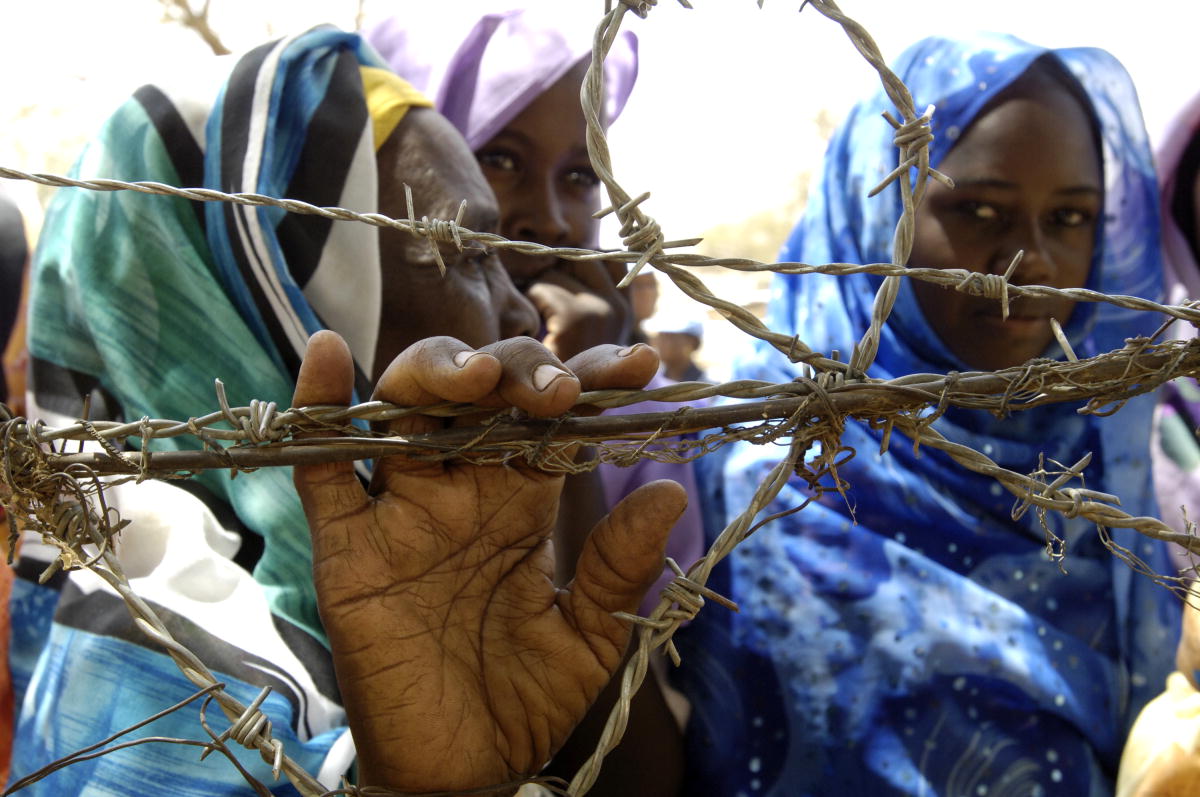
Photo from UN Photo/Tim McKulka. Internally displaced persons (IDPs) in the Zamzam Refugee Camp in El Fasher, Sudan in 2010. CC BY-NC-ND 2.0.
Considered the world’s worst humanitarian crisis, the world has turned its back on Sudan. Although the official death toll remains unknown, estimates vary from 20,000 to 150,000; the former US Envoy for Sudan believed these devastating figures were themselves conservative, placing fatalities above 400,000. Although the conflict has now entered what some have called a “Second Genocide”—primarily against the Masalit, Fur, Zaghawa, and Berti ethnic groups in the Darfur regions—these killings go beyond ethnic tensions; it is, in earnest, a proxy war. As the world is plunging into a new “era” of deadly conflict, demonstrated also in the execution of tens of thousands of noncombatants in Gaza and Iran, civilians are bearing the brunt of violence. Executive Director of the World Peace Foundation Alex de Waal argues Sudan is “a prototype of a new kind of international war,” thus testing “whether peacemaking… is still possible”—cannot be ignored. As risks of expansion of hostilities outside the country’s borders grow, civilian perspectives must be considered in diplomatic efforts, gunrunning routes and weapons bankrolling must be cut, and humanitarian corridors must be opened.
Who’s-Who, the Arms Trade, and Growing Risks
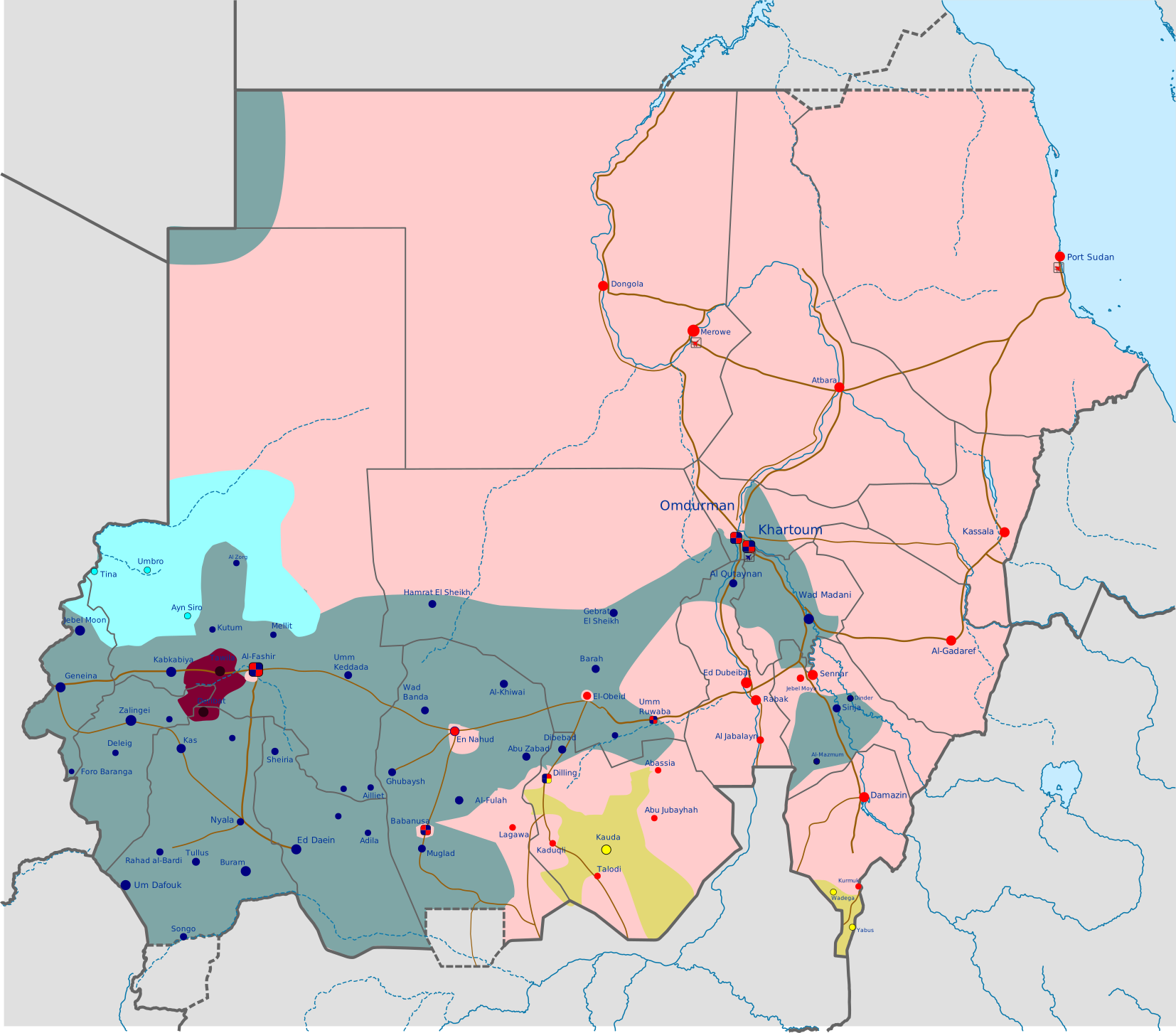
The most recent phase of the Sudanese “civil war” began with attacks on the capital, Khartoum, in 2023, with two primary commanders at its helm. The Rapid Support Forces (RSF) are a paramilitary group founded in 2013 as an evolution of the nomadic Arab Janjaweed militia, led by General Muhammad Hamdan Dagalo Musa—known by the mononym “Hemedti”—and control most western regions; the Sudanese Armed Forces (SAF) are led by General Abdel Fattah al-Burhan Abdelrahman al-Burhan—who has functioned as the de facto leader of Sudan following the 2021 military coup—and control most eastern regions. The RSF were initially founded by al-Burhan with the purpose of combatting rebels in the Darfur, South Kordofan, and Blue Nile states—appointing Hemedti as its head.

Map Created by: Julien Derroitte, Sudanese Civil War (2023–Present): 9 March 2026. Basemap from NordNordWest, Sudan adm location map.svg, CC BY-SA 3.0 DE: modified to the current phase of the Sudanese Civil War. Approximate belligerent positions sourced from: 1, 2, 3, 4, 5, 6, 7, 8, 9, 10.
Although Hemedti and al-Burhan have personal motivations fueling the war, including a friendship turned sour, each side receives funding and weaponry from numerous foreign powers, effectively making them proxies. Despite the recently renewed United Nations (UN) arms embargo against all nongovernmental belligerents within the Darfur regions—but later extended to include the SAF—weaponry continues to enter. The RSF are primarily supported by the UAE and Russia (through the Wagner Group, recently renamed the Africa Corps), with the former sending dozens of flights containing advanced arms; other minor supporters include Ethiopia, a faction of the Libyan National Army (led by General Khalifa Haftar), The Third Front, and Colombian mercenaries hired by UK-registered firms. Many provide their support with European-made arms. The SAF are primarily supported and supplied by Saudi Arabia and Russia, with minor support coming from Iran, Turkey (which has also played both sides), Egypt, China, and more.
In reality, these foreign interests and allegiances are not bipolar—and although this makes it hard to weigh arguments about both the causes and continuation of the conflict outside of pure rivalry—the constant inflow of arms are particularly to blame. These are often sent through the UAE to Chad and then Darfur, fueling tensions by generating more capabilities for battle between the RSF and SAF; these deliveries especially create instability when they are delivered ambiguously, in hidden manners, and change hands of differing allegiance often. None of these deliveries are in good faith, as all parties deny their supply to belligerents.
Of equal concern are risks of the war’s expansion into neighboring East African regions, including a recent border closure by Chad and Ethiopia’s growing support for the RSF—which may be even more prone to complicate as the country’s Tigray region is fresh off the heels of a coup. Ethiopia’s involvement—although foreseeable due to a historic feud with the SAF—is the newest development, with al-Burhan officially recognizing their aggression on 2 March. It seems Prime Minister Abiy Ahmed recognized the growing chasm between the UAE and Saudi Arabia, and has decided to side with the RSF to remain in the UAE’s good graces—which may secure its reliance on the UAE.
Leveraging Slaughter for Money
Sadly, weapon sales are hardly the beginning of the true intentions of foreign interests—most countries involved look to all sectors ripe for extracting capital, making the battlefield a playground ripe for money-making. Despite oil reserves being cut following South Sudan’s secession, Sudan remains rich in oil reserves, gold deposits, critical geopolitical trade positioning, among other resources.
Notably, gold’s value is steadying and becoming the “new oil” internationally, leading it to increasingly enter focus in Sudan, especially as oil pipeline infrastructure becomes harder to secure for both belligerents. This was apparent shortly following the breakout of fighting, after which a “scramble for gold” ensued. Endlessly hungry for funds, both RSF and SAF have since sought to secure this sector further, with the SAF expanding extraction capabilities despite the illicit smuggling boom, and the RSF consolidating deposits before shipping it primarily to the UAE and, to a lesser degree, Russia. Stained in blood, this gold has nevertheless proven to be the belligerents’ biggest lifeline—and the flow of money sees no sign of stopping soon.
Gold isn’t the end of the story. Other resources like gum arabic, food, fuel, medicine, and even Starlink devices are pillaged from local populations and under the earth of RSF and SAF-controlled territory. In addition, the country’s geopolitical positioning, particularly that of Port Sudan, remains of significant interest to Russia and China as a means to access trade through the Red Sea. In fact, a deal had promised Russia a military position on the coast in 2017, which Russia signed in 2020, and which al-Burhan—in creating follow-up agreements—has likely not pivoted his stance on. Instead, he froze it in December 2025, although only temporarily, as he waits for the public support to continue construction.

Map Created by: Julien Derroitte, Sudanese Resources. Approximate deposit positions and numbers sourced from: 1, 2, 3, 4, 5.
Decades of Instability: A Brief Historic Overview
Although today’s conflict is the “third” of multiple Sudanese civil wars, the reflection of trends persisting over decades of deadly fighting. The “first” of these wars dates back to the 1950s, as secessionist tensions rose in the systemically underdeveloped Christian south, and reached its boiling point only a year before Sudan gained independence from Great Britain in 1956. Fighting began in 1955, launching what would be a 16-year-long civil war involving a slew of interests, most of which stem from the Muslim north’s historic ethnoreligious discrimination against the south. The north’s discriminatory plight for religious dominance became a theme still present in fighting today. A stalemate was reached between belligerents through the Addis Ababa Agreement (AAA), signed in 1972, remaining relatively unknown to southerners during its drafting. Predictably, tensions were far from dispelled as the AAA lacked the teeth to address everpresent grievances. The agreement was soon violated in 1978, when President Gaafar Muhammad an-Nimeiry attempted to seize oil fields along the nothern-southern border, motivated in part by the interests of foreign actors like Chevron.
Fighting resumed in 1983 when the Sudan People’s Liberation Army/Movement (SPLA/M) founded its insurgency following al-Nimeiry’s declaration of Sudan as an Islamic state. After hundreds of thousands of deaths and tensions between the military and government, Brigadier Omar Hassan al-Bashir mounted a coup in 1989. Instead of addressing the losses the country faced, al-Bashir replaced al-Nimery’s regime with a horrific totalitarianism of his own, ultimately sponsoring the Janjaweed and effectively orchestrating the Darfur genocide—a campaign from 2003 to 2005, during which the Janjaweed executed some 200,000 non-Arab peoples. That same year, SPLA/M successes in the South gave momentum to peace talks until the Comprehensive Peace Agreement (CPA), signed on 9 January 2005. SPLA/M withdrew from the agreement in 2007 on counts of alleged violations and, following a 2011 UN independence referendum, the Republic of South Sudan seceded on 9 July 2011.
Power-sharing fallacies like that of the AAA and CPA became a recurring narrative. Al-Bashir’s regime was not out of the clear as living conditions in the country saw little progress. Ultimately, he was overthrown during the Sudanese Revolution in 2019, followed by a military coup in 2021, led by al-Burhan and Hemedti. With al-Burhan as head of the transitional military junta, and Hemedti as his deputy and remaining at the head of the country’s formidable RSF, the two quickly entered a power struggle over the direction of the country; the approximately 120,000 RSF fighters were slated to merge into the SAF, giving way for a civilian government. However, the settlement would leave Hemedti with no leading role, prompting him to keep the RSF independent, which it remains today. This culminated in the 2023 RSF attacks on Khartoum and current conflict, with the RSF now aiming to continue what the Janjaweed started and attempting—although unsuccessfully—to form its own government.
As Civilian Blood Sheds, Sudan Needs More Than Promises
After failed efforts in Jeddah and Switzerland, the United States convened the “Quad” in September 2025. Although the group is seen as the most promising diplomatic body, three of its members—Saudi Arabia, the UAE, and Egypt—are bankrolling belligerents, significantly doubting its actual investment in resolving fighting; divisions within the Quad furthermore comprise diplomacy, which itself caused the postponement of the September 2025 meeting due to disagreements over the post-conflict landscape. Nevertheless, the group released a joint statement calling for restored “peace and security” in Sudan after the meeting. The statement’s success hinges on follow-up with parties—which despite the statement still being young—is showing mixed results. The RSF agreed to the humanitarian truce, which it then reaffirmed, while the army initially called it “the worst [proposal] yet.” However, a recent announcement from Donald Trump’s advisor on Arab and African Affairs, Massad Boulos, said the Quad and both belligerents had reached a peace deal and announced goals to raise $1.5bn to support the country.
Although these are welcomed developments, no ceasefire exists, and growing attacks on-the-ground do not prepare Sudan for deescalation. Despite the support to reach a ceasefire proposal from the UN and the “Quintet,” words cannot substitute action. Some have argued for country-led mediations from countries like the US, Turkey, Saudi Arabia, Egypt, and more—however, these suffer from the same divisions within the Quad, threatening to delay even a temporary ceasefire. Thus, a three-pronged approach is necessary, where countries must enforce these steps on their own to set examples for other countries abroad:
- Continue diplomatic efforts with civilian perspectives. Diplomatic avenues, while valuable, are the status quo and, therefore, cannot soak up all the focus on solving Sudan’s crisis. However, should there be any final settlement in view, civilian perspectives and international observers—especially outside of the Quad—must be present.
- Stem the flow of arms. Increasingly contemporary, deadly weaponry—like drones—are being found in the hands of both the RSF and SAF. All actors—including governments and the organizations between them—must take action: by freezing the bank accounts of generals and their relatives, blocking business activities and flights funding Hemedti and al-Burhan (like those sent by the UAE), and digging for all international assets held by belligerents. Stopping the inflow must be of utmost priority.
- Open humanitarian corridors and launch disarmament programs. Numerous aid organizations are struggling not simply from lack of access and dangerous conditions, but critical underfunding. In light of the US’ brazen dues withholding and stepping back from the UN, other countries must step up—not shy away. These initiatives must, furthermore, extract arms from the hands of belligerents through disarmament, demobilization, and reintegration programs.
Beyond the policy level, Sudan needs attention. While protests in the wake of the increasingly deadly genocide in Gaza have brought relatively meager policy changes aimed at stopping the killing of civilians—it has, nevertheless, set the example. Given the genocidal slaughter in Sudan is one of the most ignored conflicts, bringing it to the forefront of discourse is crucial. By flooding the desks and inboxes of policymakers, it will be possible to push for change through countries’ sanctioning institutions. It is through the dollar, not ever-failing mediations, that Sudan will be free.
• • •
Julien Derroitte is a senior, studying Architecture with dual minors in international relations and political science. Julien is an editor for CM-A’s inter·punct magazine and is interested in pursuing human rights and international development.




Leave a Reply