
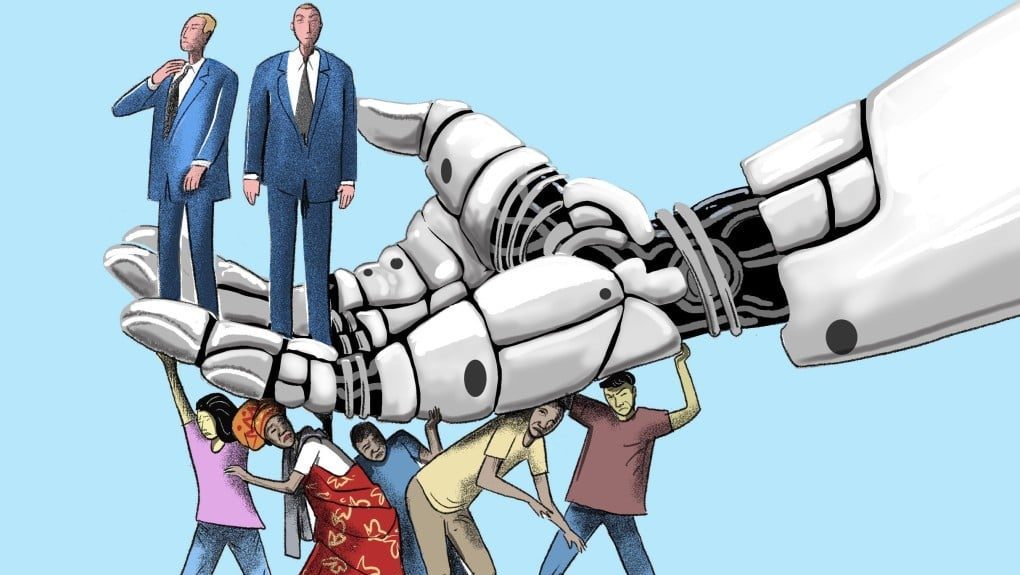
Photo from Craig Stephens/South China Morning Post.
A condensed version of this piece was published by PublicSource in December 2025; this extended version includes deeper analysis of the historical ‘productivity paradox’ and the need for structural policy interventions to ensure equitable distribution of technological gains.
Last summer, I bought a sweater from Mango for in-store pickup. Between finishing my programming prep class and moving what felt like my entire life to Pittsburgh, I forgot to complete my pickup. A few mornings ago, I stumbled upon the receipt, called the store, and was issued a refund.
That morning, I made $52.36.
Later that evening, over Meredith Grey’s “pick me” monologue, I exchanged my morning’s earnings for a pair of leather gloves that, thanks to my smart investments, came in at a satisfying $0.00.
Simple girl math.
I’ve been thinking about girl math a lot lately, not just as a TikTok trend, but as a window into cultural psychology— the way we take an outcome, wrap it in extreme optimism, and create a narrative that feels good even when the underlying logic falls apart. This line of introspection was triggered by the AI-focused events I attended, industry conferences like Workday Rising and Oracle AI World, alongside Carnegie Mellon’s “Unlocking AI for Good” event with Pennsylvania’s governor’s office.
Across all of them, I kept hearing the same refrain: “AI will handle routine tasks so humans can focus on what matters.”
The charitable interpretation goes something like this: AI will analyze medical data, freeing doctors for patient care. AI will grade assignments, giving teachers time for mentoring. AI will handle customer service, allowing workers to solve complex problems.
It’s a lovely sentiment.
The Productivity Paradox We Keep Ignoring
We’ve told ourselves this story before.
When email promised to revolutionize workplace communication in the 1990s, predictions centered on reduced workloads and streamlined operations. Instead, according to a 2025 workplace research, the average office worker receives over 100 emails daily and spends over 25 percent of their workweek managing email. The efficiency gains didn’t buy workers time; they bought employers the ability to demand higher output.
Or consider agriculture. Between its mid-century peak and 2022, the number of U.S. farms fell from roughly 6.8 million to just 1.9 million, even as the average farm size more than doubled. Capital-intensive machinery raised the minimum scale required to compete, reinforcing what agricultural economists often describe as a “get big or get out” dynamic shaped by decades of policy choices that rewarded scale, capital ownership, and exposure to market risk. One person with a combine harvester could indeed do the work of dozens, but that efficiency functioned less as relief than as a barrier to entry. Today, the largest farms, roughly the top six percent, account for nearly three-quarters of all agricultural sales. The machinery was real, but the benefits of productivity flowed disproportionately to those with the scale to own and operate it.
The wealth concentration numbers make the pattern impossible to ignore. In 2007, the world’s richest person had a net worth of over $50 billion. Today, that figure is more like $400 billion. Median wages, adjusted for inflation? Barely moved. All this in an era when technological progress was supposed to lift all boats. Instead, the boats lifted are the ones already riding high.
Why We Keep Believing the Story
The “AI handles the mundane while humans focus on meaning” narrative is seductive because it lets us avoid harder conversations about who captures value in our economic systems. It’s more comfortable to believe that technological progress naturally translates to human flourishing than to confront the reality that progress for whom is a design choice, not an inevitable outcome.
Across my event tour, from Vegas to Pittsburgh, the enthusiasm has been genuine. People want AI to help tackle intractable challenges in healthcare access, educational equity, and climate adaptation. And technically, it could. But “could” requires political and economic restructuring that have very little to do with the technology itself. When my doctor or favorite store deploys chatbots, who decides whether efficiency becomes better service for me or just wider margins for stakeholders?
At Unlocking AI for Good, speakers discussed the city’s aspirations to become a major AI and technology hub, Pittsburgh’s chance to join the ranks of Seattle, San Francisco, and Austin. The promise sounded compelling. Innovation, high-quality jobs, economic growth. What went unmentioned was what those tech booms actually looked like on the ground. Walk through San Francisco’s Tenderloin or along Seattle’s Third Avenue and the cost of tech booms becomes visible. Tent cities in the shadows of glass towers, longtime residents priced out of neighborhoods their families lived in for generations, cultural institutions shuttered because artists can no longer afford rent. It’s the same question at city scale: who captures the gains, and who bears the costs?”
The answer, historically, has been whoever holds structural power in that system. And structurally, that’s rarely workers or consumers.
What Actually Adds Up
I am not arguing against AI. In fact, I’m annoyingly enthusiastic about an AI-augmented future. I am arguing against the habit of discussing AI in a vacuum, as though it sits outside the messy, very human systems that determine who benefits and who gets left behind.
If we want AI to genuinely serve the public good: to create more time for care, creativity, and equity, then we need to start with the unglamorous structural work. This includes policy interventions that ensure efficiency gains don’t automatically flow upward, labor protections adapted for AI-augmented work, antitrust enforcement that prevents market consolidation, and ownership models that let people who create value actually capture some of it.
Until we start centering these structural conversations, we’re just doing girl math at scale. Mistaking optimistic narratives for actual outcomes, and expecting efficiency gains to magically distribute themselves differently this time.
• • •
Simi Olusola-Ajayi is a master’s student, studying Human-Computer Interaction. She is also involved with the Carnegie Mellon’s Safety Initiative and the Pre-Law Society, where she engages with interdisciplinary conversations at the intersection of technology, ethics, and law.




Leave a Reply