
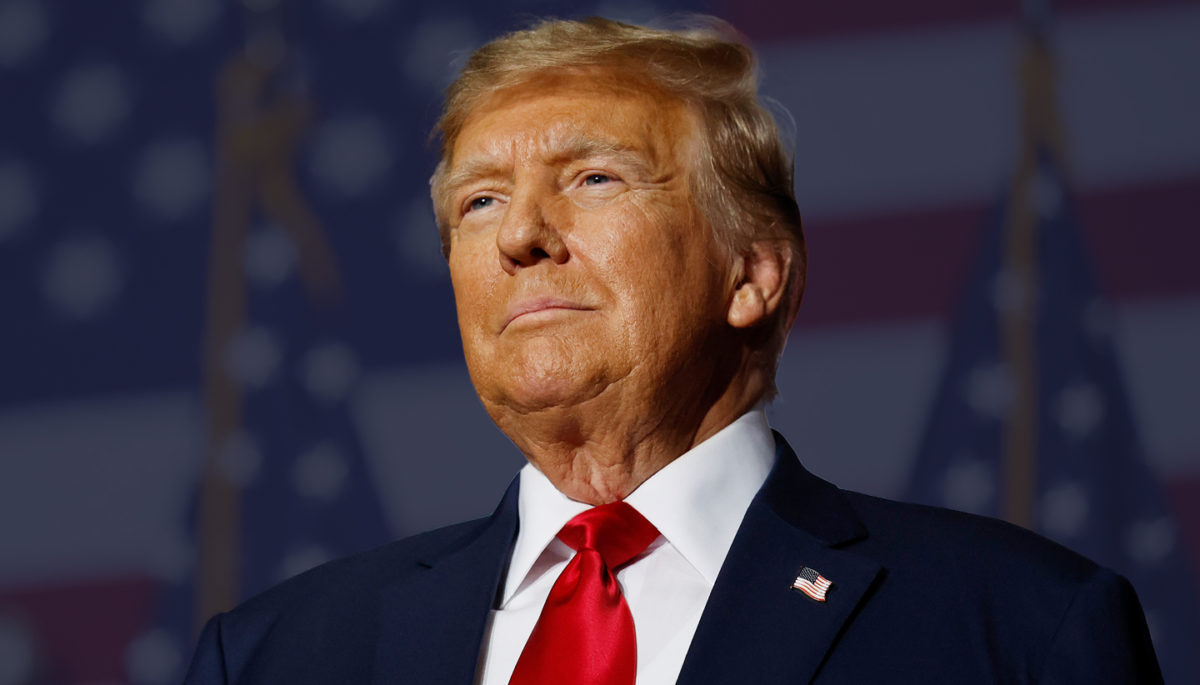
Photo by Carlos Barria/Reuters.
When billionaire-turned-politician Donald Trump was elected to serve as president again late last year, his second term immediately signaled a sharp departure from the chaos of the first. In the first few months of his second chance at the presidency, Trump did not face internal administrative riots or a firing and resignation crisis.
Instead, Trump gathered a cabinet of ideologically aligned loyalists, intent on enacting the Trump agenda as inspired by the Heritage Foundation’s infamous Project 2025. Most notably, the administration did not shy away from using governing institutions to impose consequences on individuals and groups who publicly oppose Trump. The manipulation of governing institutions against detractors is a dangerous threat to American freedoms.
When Trump’s immigration authorities sent a squad of agents to arrest lawful U.S. permanent resident and recent Columbia University graduate Mahmoud Khalil in March, the ‘cost of criticism’ of US policies became a reality rather than a hypothetical. Over the following weeks, as hundreds of students across the country were confronted with similar fates, a chilling effect would ensue that would silence pro-Palestine demonstrations on campuses nationwide.
The cost of opposition has been rising for months as a result of these attacks. When students on legal visas protest or speak out against Trump’s political agenda, they are now at risk of visa revocations, deportation, and degree revocations. Universities, even private universities and those that have already restricted student speech, are also facing threats from the government, along with demands that they increase constraints on students and withholding research funds for schools that don’t ‘adequately’ comply.
More recently however, the risk of criticism was brought back to the spotlight in the aftermath of the death of conservative commentator and Turning Point USA founder Charlie Kirk. When Jimmy Kimmel criticized and poked fun at Trump’s response to Kirk’s murder, ABC entirely dropped the show “Jimmy Kimmel Live!” after the FCC wielded broadcasting threats and political pressure against ABC, only to restore Kimmel’s program shortly afterward.
This suppression extended to the point where FCC Chair Brendan Carr publicly suggested ABC could face regulatory investigation for Kimmel’s monologue, teasing a potential revocation of the network’s entire operating license. Although Kimmel’s removal was reversed, this episode is just one example of the clear, deliberate suppression that has been rapidly accelerating in recent months.
The ongoing episode reflects a significant change: the second Trump administration is drastically more willing to aggressively silence opposition than the first. During Trump’s first term, independent media was able to poke fun at and criticize Trump largely unimpeded. Saturday Night Live and The Daily Show regularly took jabs at the administration, and despite Trump’s displeasure, they were not censored or threatened.
Today, however, Trump has launched a concerted effort to impede media push back against his actions. Even when civil society resists (in the form of lawsuits and other challenges), they are faced with an unpleasant reality: the Supreme Court is more partisan and pro-Trump than ever before, with six Republicans, including three directly appointed by Trump. As a result, the supreme court has upturned decades of precedent, namely through reversing the Roe decision, effectively reducing abortion access, and reversing the Grutter decision, effectively prohibiting affirmative action. The Supreme Court has stood by many of Trump’s most far-reaching executive actions, including some actions struck down in years past.
The MAGA GOP has intensified its use of what can only be described as salami tactics – taking bite-sized steps to erode opposition while pretending to remain moderate – mirroring the methods used by authoritarians across history. This incrementalist approach has lent itself to the formation of a highly disciplined party, enforced with fear – as Trump regularly calls out those within his party who show even slightest pushback to his demands. Since his election, Trump has attacked Kentucky Republican Thomas Massie at least eight times as a “Republican in Name Only” or “RINO” for his slightest differentiation from the Trump agenda, despite Massie never attacking Trump himself.
Trump’s heavy-handed vows to ‘make an example’ of those who oppose him are not new. They are reflected in the histories of nations across time that opted for hierarchical discipline and enforced ideological uniformity over representing the broader population. These renewed tactics reek of partiinost – the prioritization of party loyalty over principle and conscience – a policy born in the Stalinist Soviet Union and finding fresh meaning in Washington, D.C. Republican institutional culture has been reinvented and yet still faces a timid Democratic response.
Trump is systematically using government threats, regulatory control, and economic pressure to silence those who oppose him, and no opposition force has yet to stop the wave of violations against fundamental free expression. Recent months have brought multiple episodes of silencing opposition, whether through Kimmel’s cancellation, student censorship, or even the attack on media sources like AP for not embracing presidential name-changes. America has, unfortunately, crossed the path into a nation reeking of a neo-authoritarian reality marred by suppression and fear.
Now is the time for well-meaning individuals and groups on both the left and right sides of the aisle to stand up to the grossly unconstitutional crackdowns that are dominating the country. The newly reborn concept of partiinost and surge of regulator threats are antithetical to the values of this country and must be confronted. The paralyzation of political resistance fundamentally results in self-censorship and loss of freedoms for everyone, regardless of background. The new, illiberal order, should be reversed for the greater good of our country.
• • •
Zakareya Hamed is a freshman studying Economics and Political Science. He is also involved with Scottie Ventures, the Undergraduate Student Senate, the Alexander Hamilton Society, and other student organizations.


Leave a Reply