
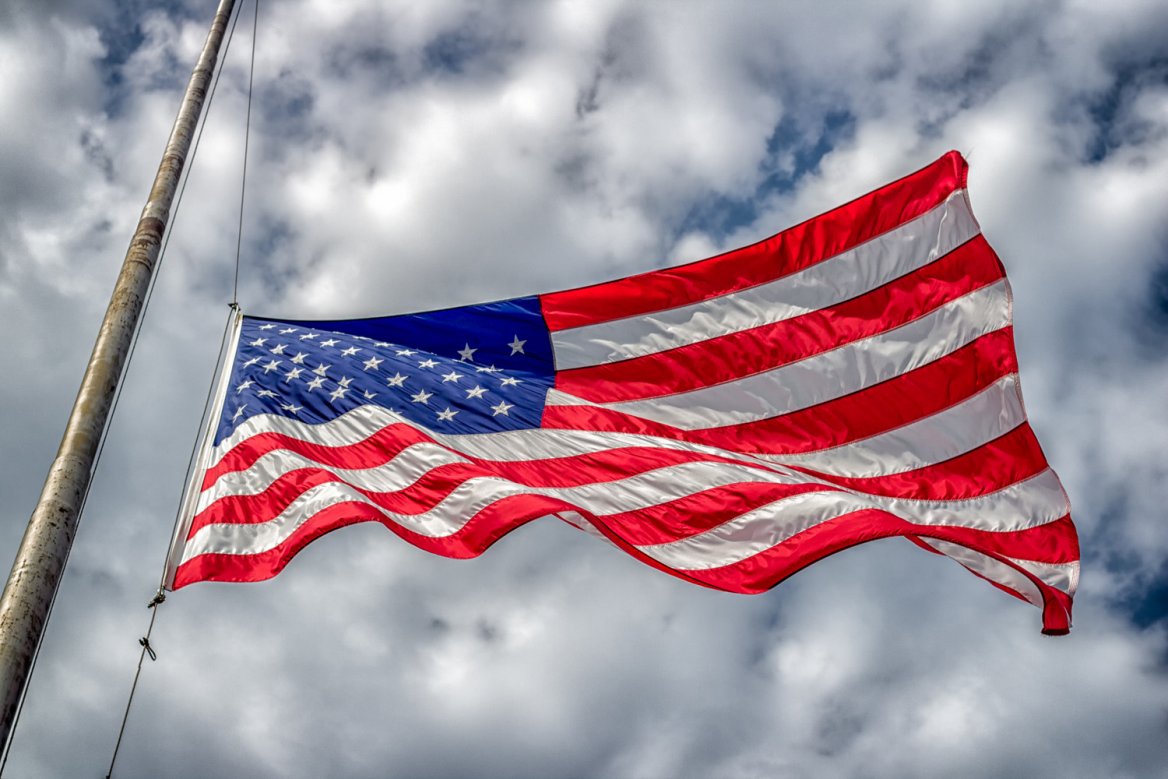
In September 2025, when conservative commentator Charlie Kirk was assassinated while speaking at Utah Valley University, the response was swift and sweeping. President Trump ordered flags flown at half-staff, Republican leaders declared Kirk a martyr, blaming the “radical left” for creating a culture of violence. Cable networks devoted wall-to-wall coverage to the killing, punctuated by warnings about liberal extremism.
Just three months earlier, Minnesota state representative Melissa Hortman and her husband had been shot dead in their home by a far-right extremist on a killing spree targeting Democratic officials. Thousands of Minnesotans mourned as her casket lay in the state Capitol rotunda, the first woman in Minnesota’s history to be honored that way. Former President Biden and other dignitaries flew in to pay their respects, and yet the White House, occupied once again by Donald Trump, declined to order national mourning. When asked why flags weren’t lowered for Hortman as they were for Kirk, Trump said simply that Minnesota’s governor “hadn’t asked.”
Two assassinations. Two tragedies. But two very different responses.
The killings of Kirk and Hortman, though equally horrifying, reveal how political violence is filtered through America’s partisan lens. Charlie Kirk’s death became a national rallying cry for Republicans, who cast him as the latest victim of leftist violence. Trump himself used the moment to declare that political violence was overwhelmingly a product of the left, never mind that data from the Anti-Defamation League and federal law enforcement show that far-right extremists are responsible for the majority of political killings in recent years. Never mind that Melissa Hortman’s murder, just weeks earlier, was part of a spree planned by a right-wing extremist with a hit list of Democratic officials. Hortman’s assassination was mourned sincerely at the state level and condemned across the aisle, but it never received the same sustained national attention or symbolic weight. Her death did not become a rhetorical weapon in the Republican arsenal, and critically, Democrats allowed the narrative imbalance to stand.
Democrats chose not to confront Trump’s double standard. They expressed grief, condemned violence, and moved on. In doing so, they missed an opportunity to highlight the greater threat posed by right-wing extremism, and to hold Republicans accountable for the rhetoric that fuels it. This silence is not new; again and again, Democratic leaders have been reluctant to call out the Republican Party as a source of radicalization, even as GOP figures traffic in language that dehumanizes opponents, spreads conspiracy theories, and paints Democrats as existential enemies.
Consider the language Trump himself uses: Democrats are “traitors,” the press is the “enemy of the people,” immigrants are “invaders.” These are not policy disagreements; they are narratives of existential threat. History teaches us when politicians describe opponents as existential enemies, some followers will inevitably take that rhetoric to its violent conclusion. This is precisely what happened in Minnesota, when Vance Boelter, a man steeped in anti-abortion anger and conspiratorial thinking, executed Hortman and targeted dozens of other Democrats.
By refusing to forcefully connect this violence to Republican rhetoric, Democrats send a dangerous message: that these assassinations are tragic but isolated, rather than the predictable outcome of a culture of incitement. The cost of silence is not merely rhetorical, it is strategic. Every time Democrats fail to highlight the connection between extremist violence and Republican rhetoric, they allow the GOP to control the narrative. Thus, Kirk’s murder becomes proof of “radical left violence,” while Hortman’s murder fades into the background noise of tragedy.
The result is an asymmetric perception of threat. Polling shows that while Americans overwhelmingly condemn political violence (over 90 percent reject it outright), partisans split sharply on who is to blame. 73 percent of Democrats blame Republicans for rising violence, while half of Republicans blame Democrats, each side points to the examples that fit their story. Without Democratic leaders amplifying the reality of right-wing violence, the public is left with a distorted balance sheet. This imbalance matters. It shapes policy debates about law enforcement resources, fuels mistrust of institutions, and influences voters’ willingness to believe warnings about extremism. If only one side is calling out the threat, and the other side is weaponizing every tragedy, the ground of debate tilts toward those willing to shout the loudest.
Democrats cannot control how Republicans spin tragedy, but they can control their own response. When a far-right extremist assassinates a Democratic leader, Democrats must say plainly that this is the foreseeable consequence of Republican rhetoric. Euphemisms about “political violence on both sides” obscure the reality; both sides have extremists, but one side has mainstream leaders amplifying extremist language. Reject false equivalence; it is true that Charlie Kirk was assassinated by a left-leaning gunman. That act was horrific, and Democrats were right to condemn it. But the broader trend is not symmetrical. Federal data show far-right extremists account for most political violence, and Democrats must point to this evidence, and hold the GOP accountable. When Republicans lower flags for Kirk but not for Hortman, Democrats must call out the hypocrisy. When Trump blames only the left, it is essential that Democrats point out the selective amnesia. Silence normalizes the double standard; Democrats must connect rhetoric to reality. ‘When Republicans call Democrats “enemies of America,” it’s important to recognize that this language can create conditions for real-world violence. The connection is not abstract; it is real, and it has already claimed lives. Some will say that focusing on Republican rhetoric politicizes tragedy, but tragedy is already politicized—by Republicans who selectively elevate certain victims to score partisan points. Ignoring that dynamic does not depoliticize violence; it simply cedes the battlefield.
The stakes are too high for deference, political violence chills democracy. If Democrats cannot connect the dots between extremist rhetoric and extremist violence, then they leave the public vulnerable to false narratives and they fail to protect the democratic institutions they claim to defend.
The murders of Charlie Kirk and Melissa Hortman should have united Americans around the principle that no one deserves to die for their politics. Instead, they revealed a double standard that corrodes democratic accountability. Republicans used Kirk’s death to amplify their narrative of leftist menace. Democrats treated Hortman’s death as a tragedy, not a warning, and the asymmetry is glaring. It is time for Democrats to stop playing defense. It is time to stop deferring to civility when civility is not reciprocated. It is time to call Republican rhetoric what it is: a pipeline from words to violence. Democrats do not need to mimic Republican bombast, but they do need to summon courage—to speak uncomfortable truths, to hold opponents accountable, and to remind Americans that extremism is not an equal-opportunity threat. Until they do, we will remain trapped in a cycle where one side incites, one side defers, and political funerals become the new normal.
The choice is clear. Either Democrats find their voice, or extremists will continue to find theirs, with deadly consequences.
• • •
Josh London is a Junior studying Ethics History and Public Policy, with an additional minor in Statistics. He is also interested in attending Law School after graduating from CMU.




Leave a Reply