
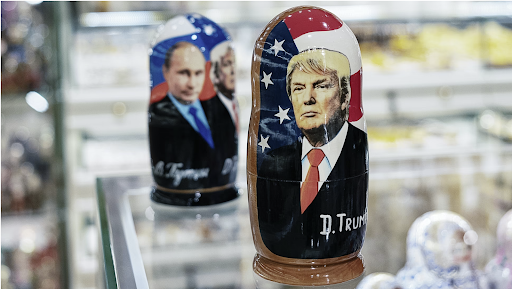
Photo from Misha Friedman / Getty.
It is rather embarrassing that President Trump isn’t an agent of Russian intelligence.
In March 2019, the Department of Justice concluded that there was no proof beyond a reasonable doubt of any sort of conspiratory agreement made between Trump and the Kremlin. This conclusion was reached amidst evidence of prolonged contact between President Trump’s staff and Russian oligarchs. Two elections later, Trump’s pro-Putin, pro-Russia, anti-FBI, anti-intelligence rhetoric is just as unwavering and permeating as it was during his first term. This rhetoric is remarkably unrepresentative of the American public, however, as 81% of Americans do not trust President Vladimir Putin.
In the past few weeks, for example, as questions about the administration’s handling of The Epstein files have dominated headlines, President Trump quipped about “[The Russia hoax], and many other hoaxes too” in an interview with Newsmax.
What both Republicans and Democrats fail to recognize regarding The Russia hoax (and many other alleged hoaxes too) is that Russian interference in 2016 and beyond had nothing to do with securing Trump’s victory. And it had everything to do with instilling distrust in democratic institutions.
So, if Trump wasn’t actually hiding a massive Russian conspiracy, it means the alternative is far more damning: America willingly elected a chief executive so oblivious to geopolitics that he —conspiracy or not—is undermining democratic institutions to coddle authoritarians. Oh, and we’re helping him to further Russia’s political agenda from both sides of the aisle.
But 2016 was the end of it all, right? Aside from President Trump’s own mindless rambling, talk of Russian interference in United States elections seems to have left America’s collective imagination. Or at least that’s the reality that Vladimir Putin (and Trump) hope to see.
On Election Day 2024, hoax bomb threats were sent to polling locations in several swing states such as Georgia, Pennsylvania, Michigan, and Wisconsin. The FBI linked all of the threats to Russian intelligence.
Bomb threats weren’t all, though. And 2016 was far from the end of Russian interference in U.S. elections. Russiagate was, in many ways, the genesis of President Trump’s mythologized ‘deep state’ that is perpetually out to get him. Conveniently, it was also the beginning of the information war that we keep losing.
U.S. officials and independent analysts have determined that Russian interference had not only carried over into 2024, but had evolved into a more sophisticated and expansive campaign.
From inflammatory videos falsely depicting ballots being destroyed in Pennsylvania to a fraudulent accusation of large numbers of noncitizens voting in Georgia (a MAGA rallying call), Russian propaganda had evolved to be more fearmongering than ever. Russia even used “troll farms” to hire American right-wing influencers to spread Kremlin talking points.
Even in a world where President Trump is in cahoots with Moscow, it would be wildly naive and self-centered for President Trump to believe that Putin’s liking to him is anything more than a pawn in his game. Putin watched Arab Spring turn into the Libyan Revolution that killed Muammar Gaddafi, and has spent the past 20 years building a digital infrastructure to ensure that he doesn’t meet that same fate and to ensure that his enemies do.
Tearing at already existing seams in U.S. democracy, Putin wants us to think that our system is just as bad as his.
After dissecting the polarizing rhetoric omnipresent on social media, Putin’s mechanization became clear. More than 66% of Facebook adverts posted by the first wave of Russian troll farms contained a term related to race. A Senate report even found that posts promoting messages like “Our Votes Don’t Matter,” “Don’t Vote for Hillary Clinton,” and “A Vote for Jill Stein is Not a Wasted Vote” were specifically targeted at black voters.
One of the most unsettling overlaps in Putin’s playbook is the overlap between Facebook’s business model and the Kremlin’s political goals. Facebook’s algorithm weighs dislikes 5x as much as likes; creating an information vacuum in which individuals are fed diametrically opposed pieces of content intended to spread the message that Americans are irreconcilably divided.
Vladimir Putin slam dunks every time MAGA moms argue about trans kids in sports in Facebook comment sections or a liberal teenager reposts a pretty infographic from Impact to their Instagram story. We even see this kind of manufactured division inside of political parties themselves. The only key difference between Russia’s 2016 “Hack and Leak” DNC Operation that started this all and what is happening now is that the infighting no longer needs to be engineered from the outside—it is sustained and amplified from within.
So in a classic horror movie sense, the call is now coming from inside the house. We don’t need Russia to interfere anymore. It is also probably important to note that no new tariffs have been placed on Russia since Trump’s second presidency. Rather than working to fight this persisting interference, the Trump administration is once more colluding with Russia to mislead the American people.
So I would like to leave you with a question: Why are you following the people you follow? Are you following them because they’re telling you the truth about the world around you, or are you just playing a game of Russian roulette?
• • •
Presley is a sophomore studying International Relations & Political Science as well as Ethics, History, & Public Policy. She is an executive officer on Carnegie Mellon’s Pre-Law Society and Parliamentary Debate Team. She is also a member of the Carnegie Mellon University Cheerleading Team.



Leave a Reply