
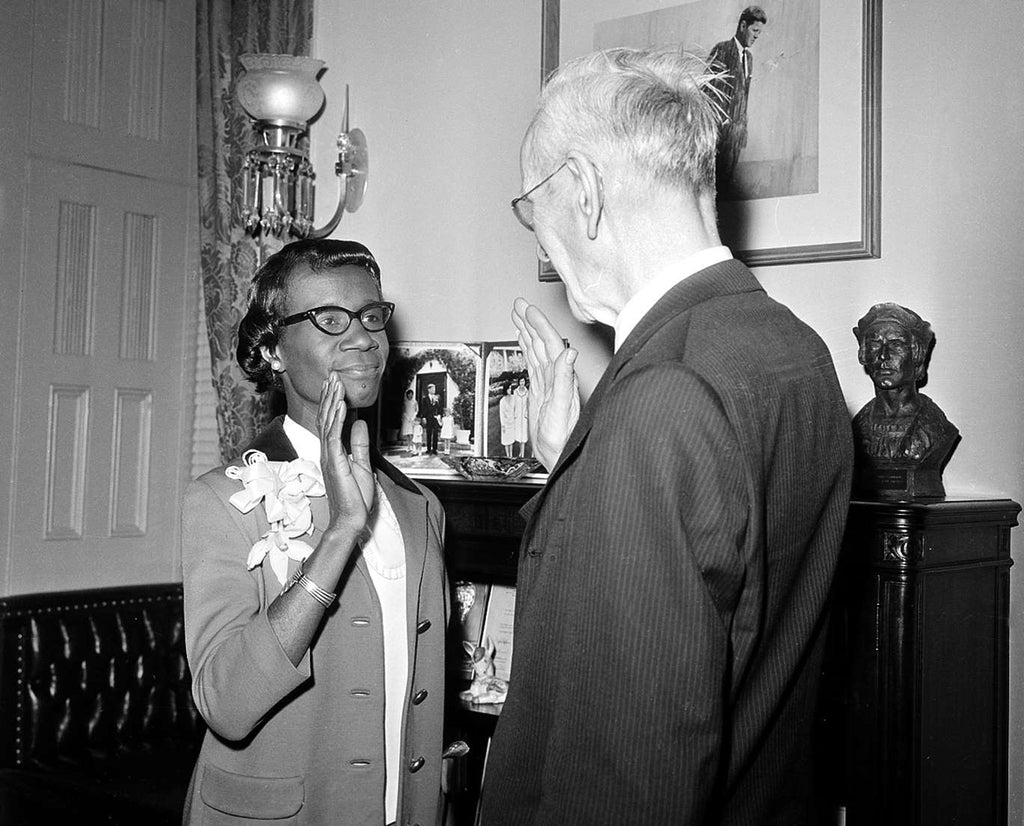
Photo from AP.
The United States of America is a country built on the voices and stories of its people. A democracy is built on representation that is more than a matter of numbers; it is a reflection of who is invited to shape the nation’s priorities, frame its debates, and influence the laws that impact millions of lives. When a group is significantly underrepresented in Congress, the ripple effects are not abstract. They are practical, political, and deeply human. Black women’s underrepresentation in Congress exemplifies this dynamic, with impacts far beyond the chamber’s makeup.
Every law begins with a point of view: someone noticing a problem, caring about it, and deciding it deserves national attention. Black women often sit at the intersection of multiple experiences: racial discrimination, gender inequality, economic inequity, health system disparities, and caregiving burdens that stretch across generations.
When this intersectional lens is missing from the congressional table, specific issues remain underexplored or misunderstood. Conversations around maternal health, criminal justice reform, workplace equity, immigration, veterans’ services, and voting access can lose nuance without voices that personally understand how these issues overlap in daily life.
Representation influences what lawmakers consider urgent, what they frame as solvable, and how boldly they push for change.

So what do the statistics tell us about Congress:
- Women make up 28% of all voting members of Congress (150 of 533).
- People of color make up 26% of Congress, even though 42% of the U.S. population is non-White.
- The number of women of color in the 119th Congress is the same as at the start of the 118th Congress, making it the first time in about 15 years that a count has not been higher than the one before it.
And here’s a detail that doesn’t get enough attention: only 24 states have ever elected a Black woman to Congress. That means more than half of U.S. states have never had a Black woman speaking on their behalf on Capitol Hill.
This is not just a numbers problem; it is a power problem.
In the 118th Congress (2023), there were 29 Black women in the House of Representatives, and none in the Senate, marking a historic achievement. That emptiness in the upper chamber emphasized who our democracy sees as “electable.” Black women were not running in lower numbers because they lack ambition, qualifications, or voter support. They are constrained by structural barriers that other demographics will never face.
Today, with the 119th Congress (2025) sworn in, the picture looks a little different, but not nearly different enough. There are now 31 Black women serving in Congress, part of 61 women of color overall. For the first time in U.S. history, two Black women are serving in the Senate simultaneously: Senator Angela Alsobrooks of Maryland and Senator Lisa Blunt Rochester of Delaware. That’s historic. It is also still far from proportional representation.
Black women have historically been among the most civically engaged groups in the country, consistently voting, organizing their communities, and leading grassroots movements. Yet, this civic engagement does not translate proportionally into elected leadership when the lived experiences of such a politically active community do not appear in policymaking bodies, a disconnect forms between what voters raise and what Congress chooses to pursue.
For example:
- Discussions on healthcare may not fully integrate the realities of disproportionate maternal mortality among Black women.
- Economic policies may overlook the ways wage gaps compound across race and gender.
- Education debates may miss how school discipline policies differently affect Black girls.
Despite years of data showing that Black women in the U.S. are three to four times more likely to die from pregnancy-related causes, policies aimed at reducing maternal mortality have often been inconsistent or underfunded. Efforts such as expanding Medicaid postpartum coverage, addressing provider bias through training programs, or supporting community doula services have been introduced in some states, but without strong federal oversight or sustained investment, progress remains uneven. In the last session of Congress, 39 maternal health proposals were introduced, with 18 having Democratic and Republican cosponsors, demonstrating bipartisan support. Despite that support, none of these bills were passed.
While the discussion around this topic often focuses on the health imperative, as seen in our everyday politics, money talks. McKinsey recently released a report outlining the economic benefits of passing these laws, stating that closing the Black maternal-health gap in the United States could increase the nation’s economic output by as much as $25 billion. Having more Black women in Congress increases the likelihood that these policies are not only proposed, but monitored, funded, and shaped by lived experience. These blind spots are often unintentional; they emerge because the people in the room have not personally experienced these realities.
Visibility is not just a matter of politics; it is also a matter of psychology. Seeing someone who looks like you shape national decision-making can influence their perceptions of the government. The underrepresentation of Black women can reinforce a sense that the halls of power are closed or selective, which affects trust, civic participation, and belief in the system’s responsiveness. When representation expands, it communicates something powerful:
“This government sees you. This government includes you. This government considers your story part of the national story.”
Congress functions best when it draws from a wide range of life stories. Diverse representation helps avoid narrow solutions, flag unintended consequences, and build coalitions that cross lines of geography, class, race, and ideology. Black women in Congress have historically been coalition builders, often bridging party divides, advocating for overlooked communities, and elevating issues that benefit broad swaths of the population. Carol Moseley Braun was the first Black woman elected to the United States Senate, serving from 1993 to 1999; her victory was one many thought could not be achieved at the time. According to her own reflections, during her earlier career in the Illinois state legislature, she accomplished legislation “by working in a bipartisan fashion, particularly as an independent Democrat. I wasn’t tied to the machine. That meant that for whatever it is you want to do, you try to develop coalitions that would get you enough votes.” Their underrepresentation means a loss of that connective potential, which weakens the overall fabric of legislative problem-solving.
American democracy should reflect the will of the people, yet the continued underrepresentation of Black women in Congress weakens that promise. When their voices are missing, the nation loses valuable insight, talent, and leadership that could strengthen policymaking and make it more effective and equitable. This underrepresentation also carries symbolic costs: young Black women deserve to see themselves in positions of power, and the country deserves leaders who fully reflect its diversity. Until Black women hold proportionate influence in government, America will continue to operate with blind spots and an incomplete vision of who we are and whom we can become.
Their victories should not be rare. Their presence should not be historic. Their leadership should not be exceptional; it should be normal.
As a nation, we must begin to ask whether our government is meant to represent and serve the diverse people of this country, or whether our government is meant to continue functioning with underrepresentation.
• • •
Elijah Dourado is a senior, studying International Relations and Political Science. He is also involved with Carnegie Mellon’s Alexander Hamilton Society, College Democrats, Elections Board Committee, and other organizations.


Leave a Reply