
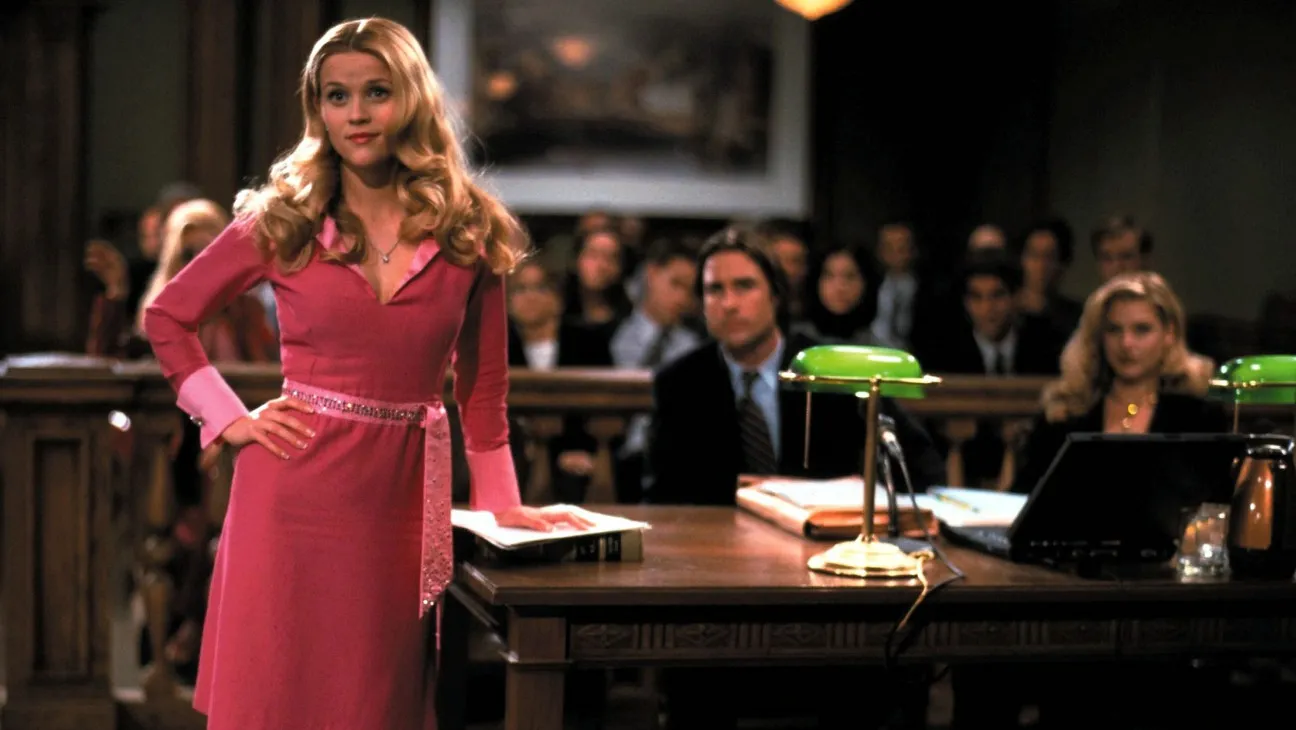
Photo from Photofest.
Though the majority of the film Legally Blonde takes place at Harvard Law, when one thinks of the 2001 romantic comedy, they may be quick to assume that this film doesn’t have anything to say other than “Bend, and snap!” Yet, the pink aesthetics of Legally Blonde are not frivolous; rather, protagonist Elle’s journey to becoming a lawyer is an incredibly clever and subversive exploration of the experience of women in the legal field. The media we consume often represents a perspective or particular angle of the world around us, and in the case of films that portray the legal field, every decision in conveying what the law is, how it manifests, and who gets to practice it and benefit from it is meaningful.
One of the main themes of Legally Blonde is rejection of stereotypes and assumptions, specifically based on gender in Elle’s case. Elle is a thin, white, blonde, sorority girl—a group often stereotyped as being physically attractive but lacking intelligence. Even before Elle decides to pursue law school, she demonstrates argumentative prowess and wit, but the way she presents herself to the world causes many people to disregard her. When Elle browses a clothing store with her friends, a sales associate turns to another worker and jabs, “There’s nothing I love more than a dumb blonde with Daddy’s plastic.” The woman then approaches Elle with a dress off of the sales rack that she had removed the tag from, though she tells Elle they received the item just yesterday as to trick Elle into paying full price. Elle asks a few questions about the fabric and stitching in mock excitement until she reveals that she saw the dress in a Vogue issue a year ago and has not been tricked. Elle responds, “You picked the wrong girl.” At this point in the film, Elle is not at all interested in pursuing a legal career but exemplifies key skills needed to be an attorney: she is quick, astute, pays attention to details, and stays firm in her assertions. Elle is highly knowledgeable about fashion and makeup, but because these areas are traditionally associated with femininity and thus deemed superficial, her intelligence is thrown aside.
Repeatedly through the film, Elle is judged by her hyper-feminine presentation. She may perform femininity ‘correctly,’ but she is therefore boxed in and told she cannot enjoy traditionally feminine things like getting a manicure or wearing pink and succeed as a lawyer. Elle proves this dichotomy to be false in the climactic court scene where Elle cross-examines Chutney, Elle’s client’s step-daughter. Elle latches onto the fact that Chutney had gotten a fresh perm the day before her father’s murder, but her alibi was her being in the shower during the murder—impossible due to the rules of perming. Elle is able to prove her client innocent because she is knowledgeable on this cosmetic topic, a traditionally feminine and, thus seen as inconsequential, one. Legally Blonde portrays a highly interesting exploration of women in the legal field—even a conventionally attractive, thin, straight, white woman is barred from entry into the boys’ club of law school and the greater legal field.
Another key theme in Legally Blonde is female solidarity and friendship. Elle is primarily introduced in her role as sorority president. The first sequence of the film follows Elle as she prepares for her day in her room, and the camera highlights the camaraderie and tight-knit nature of the sorority through shots of various girls passing along a handwritten note to Elle. Even when Elle decides to apply to Harvard Law, an unexpected choice, Elle’s sorority sisters rally around her. Her friends administer her practice LSATs and when her score finally arrives, the entire sorority gathers around her to support her and subsequently celebrates her victory in being accepted to Harvard Law. In this community, Elle is best set up to achieve what she sets her mind to and given the support needed to accomplish whatever she desires—Elle directly benefits from the strength of a collective grounded in friendship and womanhood.
This film also highlights the importance of third places, especially for women, in its portrayal of the nail and hair salon where Elle goes in Boston. After feeling dejected and out of place at Harvard, Elle stumbles upon Neptune’s Beauty Hook, a nail and hair salon, and subsequently befriends nail technician Paulette. Elle vents and Paulette offers her a listening ear as she paints Elle’s nails—in the unfamiliar and daunting territory of law school, Elle finds solace in the company of other women in a space made for women. Later on, the iconic “Bend, and snap!” scene where Elle tutors Paulette in flirting is known for its comedic and energetic nature. However, this scene also serves to demonstrate the completely unique atmosphere of a space built around traditionally feminine self care and occupied by majority women. Here, Elle can be unabashedly herself and is applauded for her knowledge of traditionally feminine areas, just as she was safe in her sorority house. Her transition to Harvard Law is rocky largely because Elle does not fit the traditional image of a lawyer; however, she discovers that her unique power as a lawyer is her being different than the norm through her ability to create bonds with, lean on, and champion the women around her.
While Elle’s female friendships are central to her character, the first conflict she encounters upon arriving at Harvard Law revolves around her competition with another woman. When Elle reunites with her ex-boyfriend Warner, she is shocked to find out he is engaged to another woman, Vivian. Vivian is the opposite of Elle, and at this point, everything Elle wants to be as she is the current object of Warner’s affections; Vivian is brunette, comes from a prestigious family, and seems to effortlessly fit in within law school because she can be intelligent due to her not being a “dumb blonde.” At first, Elle and Vivian are enemies. However, the women began to become friends as Vivian respects Elle’s dedication to maintaining their client Brooke Windham’s privacy. When Elle works on Brooke’s case as a part of her first-year internship with Professor Callahan, she cements herself as staunchly prioritizing her female friendships. Elle and Brooke immediately bond as they are a part of the same sorority and Elle ceaselessly champions Brooke, even as her colleagues judge Brooke and fail to give her the correct legal support due to her physical presentation and reputation as a fitness instructor. Elle’s commitment to female friendship is the very thing that allows Elle to begin another friendship with Vivian, a woman she may not relate to at first glance. The legal field is at times known to be individualistic and competitive at the fault of others, but Elle’s character growth offers an alternative in a supportive community of legal professionals—one that is successful in offering their client the counsel they need.
Legally Blonde, while a beloved romantic comedy with keystones of the genre, is also a subtle critique of the misogyny of the legal field and the alternative that dismantling the norm may offer. Maybe the law can be more properly carried out with a little bending and snapping to the boundaries of who we deem qualified to bring justice to all citizens.
This piece was inspired by the most recent installment of CMU Women in Law’s Fry-Day Feminist Flicks series.
• • •
Katina Handrinos is a first-year, intending to study Film and Visual Media as well as Dramaturgy. She is involved with Carnegie Mellon’s Scotch’n’Soda Theatre, Women’s Club Basketball, and the Hellenic Student Association.


Leave a Reply