
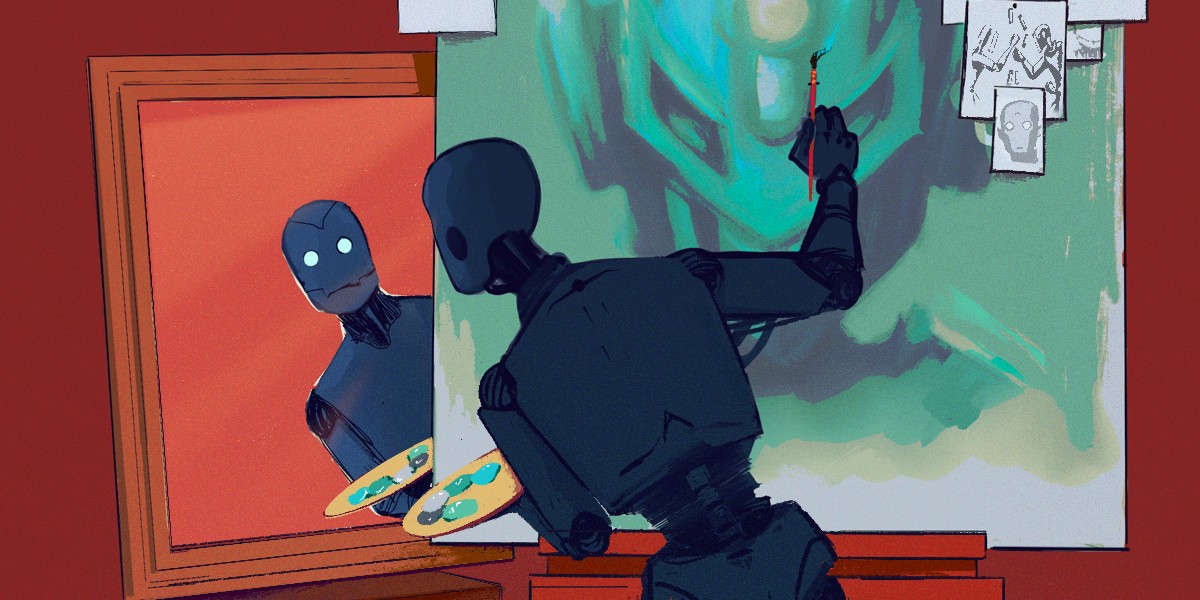
Photo from Electronic Frontier Foundation.
What do platforms like Spotify, X, and Instagram have in common? One, they are all platforms for artists around the globe. Two, they are currently experiencing an artist exodus.
Artists have increasingly relied on these platforms to promote their work, resulting in a “platformization” of the creative industry and the emergence of the Online Platform Economy (OPE). The OPE refers to the marketplace where digital platforms act as “intermediaries” between buyers and sellers, and the phenomenon has not only attracted user engagement but has become a major driver of economic growth, with the creative industry now representing a whopping 3.1% of the global
So, why are artists leaving the platforms that support their livelihoods? The answer has to do with the continual innovation and implementation of technology, particularly AI. Namely, while AI can do everything from “[generating] scripts” to “analyzing user data,” it has become a thorn in the side of intellectual property and copyright law. X recently experienced a creator exodus due to the introduction of an image-editing feature that utilized AI, resulting in artists’ work being modified without “consent or proper compensation.” Instagram and Spotify have also experienced their own migrations due to similar fears regarding appropriation and compensation.
Intellectual property rights are essential to the economy, as they protect incentives to create and innovate. Art and the creative industry in particular have been historically integral to technological innovation—ranging from the construction of the pyramids to the invention of photography—and continues to be an underrated yet significant source of innovation today. The creation of platforms like Spotify are themselves examples of this innovation, contributing to the OPE becoming a staple of the economy-at-large. Artists also contribute to innovation through digital art, with technologies such as virtual reality (VR) and Non-Fungible Tokens (NFT).
However, AI is souring the once-complementary relationship between art and technology due to the lack of copyright protection and enforcement. A significant part of this problem is the absence of a universal definition of ownership, which not only poses an issue for discussions between creators and the Copyright Office but also has resulted in a lack of cohesion in legal rulings across the country. The gaps in copyright definitions may also exacerbate existing inequity in copyright law and its enforcement—which already “privileges intellectual property conglomerates rather than individual creators”—by leaving room for biased interpretations. In turn, the dominance of large firms can potentially “stifle innovation,” further motivating the need to strengthen copyright law.
The long-term economic impact is not immediately obvious: AI seems to be having a positive effect on the OPE, with total sales of images rising by 39%. However, it has also resulted in direct competition between AI and non-AI art, with non-AI art purchases dropping. This competition elicits the classic Lemon’s problem by George Akerlof, where AI-art sellers take advantage of the lack of proper copyright protections. Because consumers thus cannot distinguish between AI and non-AI art, creators are currently being “squeezed out” of platforms, with the alternative to exiting the market being to “voluntarily decrease the quality of their products.” As such, the market becomes inefficient while also discouraging innovation and creativity.
Creative output is so important because it is a form of long-run social welfare, with those benefits being a direct result of innovation and the “experimentation process.” Moreover, AI art decreases revenue and “the value of the underlying human work”: although the OPE has recently been thriving, it has also historically experienced high turnover rates and depressed wages that stagnated its growth. The devaluation of artist work and the resulting exodus from platforms will likely exacerbate these problems, threatening a stagnation of the creative industry once again.
There is some indication of innovation occurring as a direct result of the artist exodus: Cara is one such example, being a new anti-AI art platform. However, the platform is simply a temporary safe haven for artists, and does not solve the systemic problem of AI and copyright. AI programs are still able to extract and use data from the platform without permission, and Cara’s current statements on AI may leave room for relaxed AI policies in the future.
Although the importance of the OPE may seem overblown to some, there is evidence that the OPE reflects “broader” economic trends such as the “casualization of work,” which is defined by the lack of set working hours and is characterized by the very same “job insecurity” and “low wages” that plague OPE participants. Thus, it is imperative that we do not neglect the problems of the OPE and creative industry lest those problems hold implications for the economy at large.
The value of art transcends simple economic profit or any other quantifiable number, and truly encapsulates the spirit of creation that copyright law aims to protect. However, AI threatens the incentives that drive creativity, and the weak status quo of copyright law and enforcement only worsens inequality and exploitation. If we do not recognize the importance of the creative industry, we may ruin the very innovation that we pride ourselves on, leading to broader economic instability. It is imperative that we advocate for stronger protections, and hold the government accountable in enforcing those protections so that we not only preserve the economy, but also the integrity of artists’ work and livelihoods.



Leave a Reply