
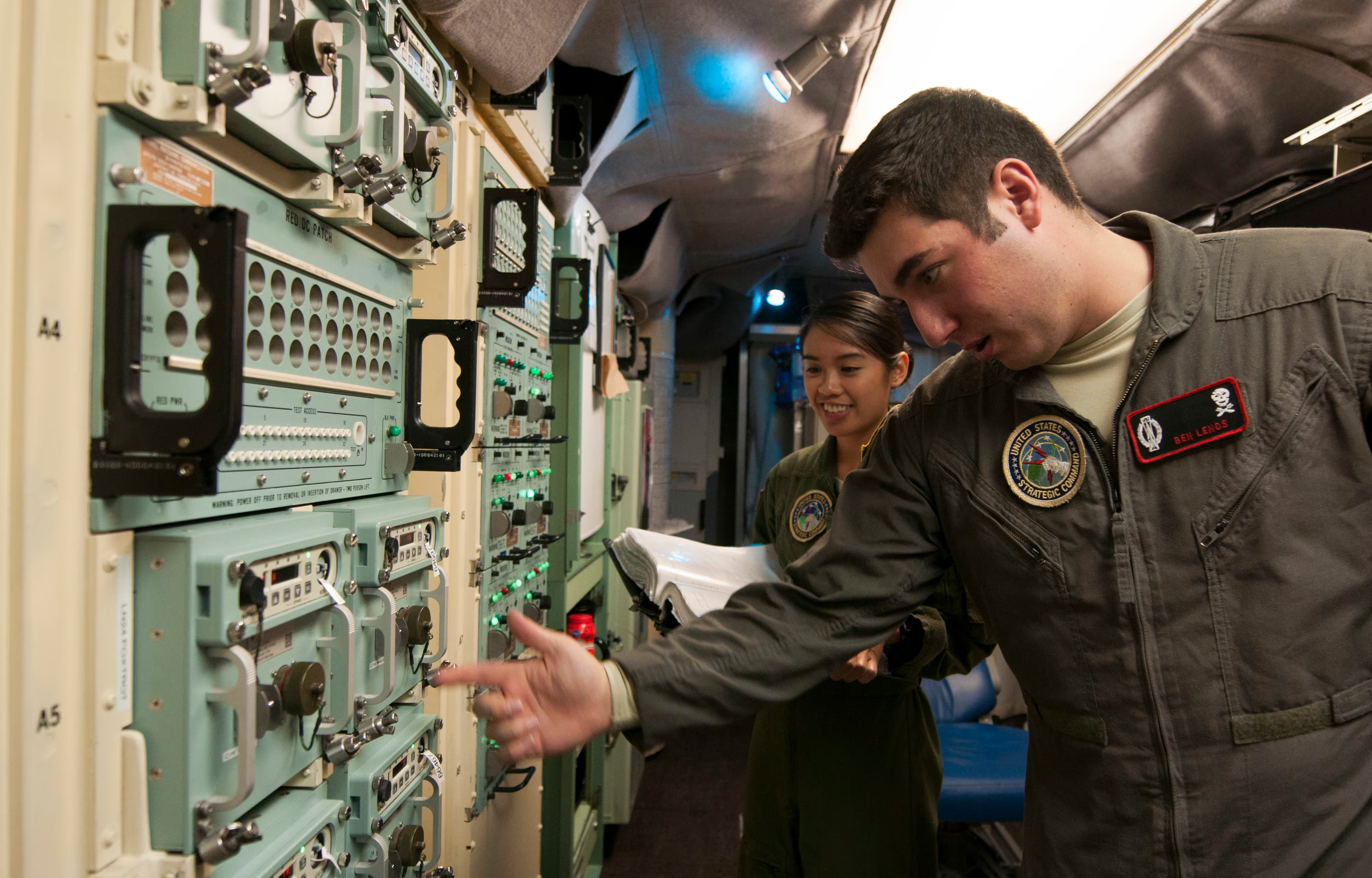
Photo from Staff Sgt. Christopher Ruano / Defense News.
United States nuclear forces face an inflection point. Two-nuclear armed peers in China and Russia are expanding and modernizing their forces, and at the same time, US nuclear forces are outdated, with recent modernization efforts facing mounting challenges and expenses. How the US responds to this new nuclear dynamic will heavily impact the nation’s foreign policy for the next decade.
The War on Terror and decades of US global dominance have gradually pushed nuclear weapons out of their Cold War spotlight. Today, only 30% of the US public is “at least somewhat” familiar with nuclear policy, and to many, nuclear weapons are simply a Cold War relic: horribly destructive, but from a meaner age when leaders contemplated biblical destruction at the push of a button. In reality, nuclear weapons still shape the nation’s foreign policy and are often misunderstood or ignored by many Americans.
What are Nuclear Weapons?
Nuclear weapons are explosive devices that harness energy from splitting atomic nuclei to produce destructive effects. They are unique because they concentrate immense destructive power in a relatively small amount of mass for delivery. For instance, the Tsar Bomba—the most powerful nuclear weapon ever detonated—was only 26 feet long, but had 50 megatons of explosive energy, or ten times more than all the ordnance exploded during World War II.
The Tsar Bomba, however, is not representative of most modern-day nuclear weapons. For instance, the w76—the most common warhead type used for nuclear weapons on US submarines—has 100 kilotons of explosive power or 0.2% of the Tsar Bomba. A single w76 detonated at Point State Park would only achieve light blast damage of 1 psi, or enough to shatter windows, at CMU’s campus, less than 4 miles away (*Calculation is based on public estimates and assumes a 100 kt airburst. For a more detailed look see https://nuclearsecrecy.com/nukemap).
That is not to say nuclear weapons are not incredibly dangerous. They can have devastating effects in populated areas or when deployed in large numbers across a wide area. However, it’s important to remember that nuclear weapons have discrete effects that can be measured, mitigated, and tolerated by leaders in conflict scenarios. Understanding the actual dangers and limits of nuclear weapons is the first step to understanding international nuclear dynamics.
Why does the US have Nuclear Weapons?
The US generally uses nuclear weapons to help maintain deterrence: discouraging adversary action by signaling the ability to inflict pain in response to that action. Without nuclear deterrence, it would be much more tempting for adversaries to launch nuclear or conventional attacks on the US homeland and allies. Furthermore, nuclear deterrence can prevent coercion as adversaries cannot credibly threaten to attack the US with nuclear weapons without expecting a similar response.
Nuclear deterrence is not a static concept: “if I nuke you, you will nuke me, therefore it’s irrational to nuke anyone.” Instead, nuclear deterrence is interlinked with conventional conflict. During the Cold War, US nuclear forces were also tasked with deterring a conventional Soviet invasion of Western Europe. It also requires daily action to signal continued resolve. US ground troops were stationed in Berlin for nearly 50 years from 1945 to 1994 to continually deter a Soviet takeover of the city and similarly, the US deployed nuclear weapons in Europe throughout the Cold War to support this position.
Additionally, nuclear deterrence is not just about preventing a massive attack. It must also counter the use of smaller, “theater,” nuclear weapons on the battlefield, which are more common in Russia’s arsenal. Finally, nuclear deterrence is subject to shifting technological realities. Historically, new advances in navigation, rocketry, and, more recently, missile defense systems have changed the effectiveness of certain nuclear weapons, complicating the existing dynamics of nuclear deterrence.
Thus, nuclear deterrence is not a law of nature. Deterrence can fail, and strong, capable US nuclear forces are the main way the US maintains its nuclear deterrence against capable peers.
Challenges facing US Nuclear Forces
The US now faces two nuclear peers in Russia and China. China is on track to expand its nuclear arsenal from 200 warheads in 2020 to 1,000 by 2030. China has also restarted nuclear testing (breaking its own voluntary moratorium), and recently test-launched a long-range ballistic missile from one of its nuclear-powered submarines in the South Pacific, signaling increased nuclear capabilities in an ostensibly nuclear-free zone.
Meanwhile, Russia has continued to modernize its arsenal. It has also added new nuclear technologies like a nuclear anti-satellite weapon and nuclear-powered cruise missile, which offer novel and difficult-to-counter capabilities. Furthermore, Russia has followed up this modernization with increased nuclear belligerence, including de-ratifying the Comprehensive Nuclear Test Ban Treaty in 2023 and threatening to use nuclear weapons on the battlefield in Ukraine.
These developments present distinct challenges for the US. Countries with larger, more diverse nuclear arsenals can hold at risk more or better defended targets and gain the flexibility to exploit escalation dynamics an opponent might struggle to respond to. These developments and improvements can significantly undermine the US’ nuclear deterrent efforts.
The Deficiencies of US Nuclear Forces
The US has struggled to adequately face the challenge of two nuclear peers: an in-depth congressional review commissioned by 2022 National Defense Authorization Act concluded that the US was “ill-prepared” to face the “existential challenge” of a two-peer nuclear threat and therefore lacks a comprehensive strategy and supporting force structure.
A review of US nuclear hardware and its modernization timelines confirms this bleak assessment. The Air Force’s Minuteman III (MMIII) land-based missiles were first deployed in 1970 and designed to last 10 years. Almost 60 years later, the MMIII’s replacement will not be ready till 2029. Similarly, the Ohio Class Ballistic Missile Submarines were first deployed in 1981, designed to last 31 years, and will begin phasing out in 2031—50 years later. In the air, the US is in better shape with the brand-new B-21 and newer B-2 and F-35 platforms, but the B-52H, one of the US’ main strategic bombers, was first introduced in 1955 and is expected to be in operation, with major updates, through 2050—almost 100 years after it entered service.
The situation is similar for the US’ nuclear warheads. The US has not manufactured a new warhead in over 30 years, and its current warhead stockpile was mainly produced in the 1970s and 80s with an original design life of 20 years. Furthermore, the US cannot currently produce plutonium pits, a key component of nuclear weapons, and thus cannot make new nuclear warheads even if it wanted to. Similar problems extend to the US’ Nuclear Command, Control, and Communications (NC3) infrastructure and workforce.
Older systems increase maintenance burdens as they require parts that are no longer in production or the use of untested replacement processes and components. They also have to contend against increasingly modern and more capable systems built in the 21st century. Finally, they speak to a larger problem amongst US strategists of taking nuclear forces for granted, as these systems were allowed to persist long beyond their intended lifetimes.
The Existential Challenge Played Out
The US will spend nearly $1 trillion over the next decade to update its nuclear forces, but it’s unclear whether these forces and their accompanying strategic deployment will be adequate to meet the two-peer challenge. For the public, this development suggests several takeaways.
(1) Nuclear is “important” again. Twenty years of US international dominance and the Global War on Terror have accustomed the public and decision-makers to largely take nuclear deterrence for granted. Now, with two ascendant nuclear peers and other nuclear problem spots like Iran and North Korea, nuclear considerations must return to the forefront of US thinking.
(2) The US needs to fix its strategic thinking. US nuclear forces were allowed to significantly degrade after the end of the Cold War. This mistake left the nation scrambling to catch-up and illustrates a strategic thinking addicted to short term priorities and missions. As the US faces increasingly powerful rivals, it cannot allow short-term strategic thinking to always leave it playing catch up.
(3) Turning inward is not an option. With a host of domestic priorities, it’s incredibly tempting for the US to hide behind its oceans and embrace an isolationist mindset, much as it did after World War I. Hiding, however, is not possible in an age when nuclear weapons can cross oceans in half an hour. Nuclear considerations inherently bring global ones, and as a result, the US cannot afford to turn inward again.
The nuclear challenges facing the US are immense, and it’s tempting to either despair beyond reality or ignore beyond rationality. These challenges, however, are solvable, and what the US needs is people willing to solve them. For years, the public and decision makers have largely taken nuclear weapons for granted. That age must end now.
• • •
Ryan is a graduate student, studying Strategy, Technology, and International Relations. He has worked in cybersecurity and strategic deterrence supporting national security. He is also a varsity athlete on Carnegie Mellon’s Track and Field team.



Leave a Reply