
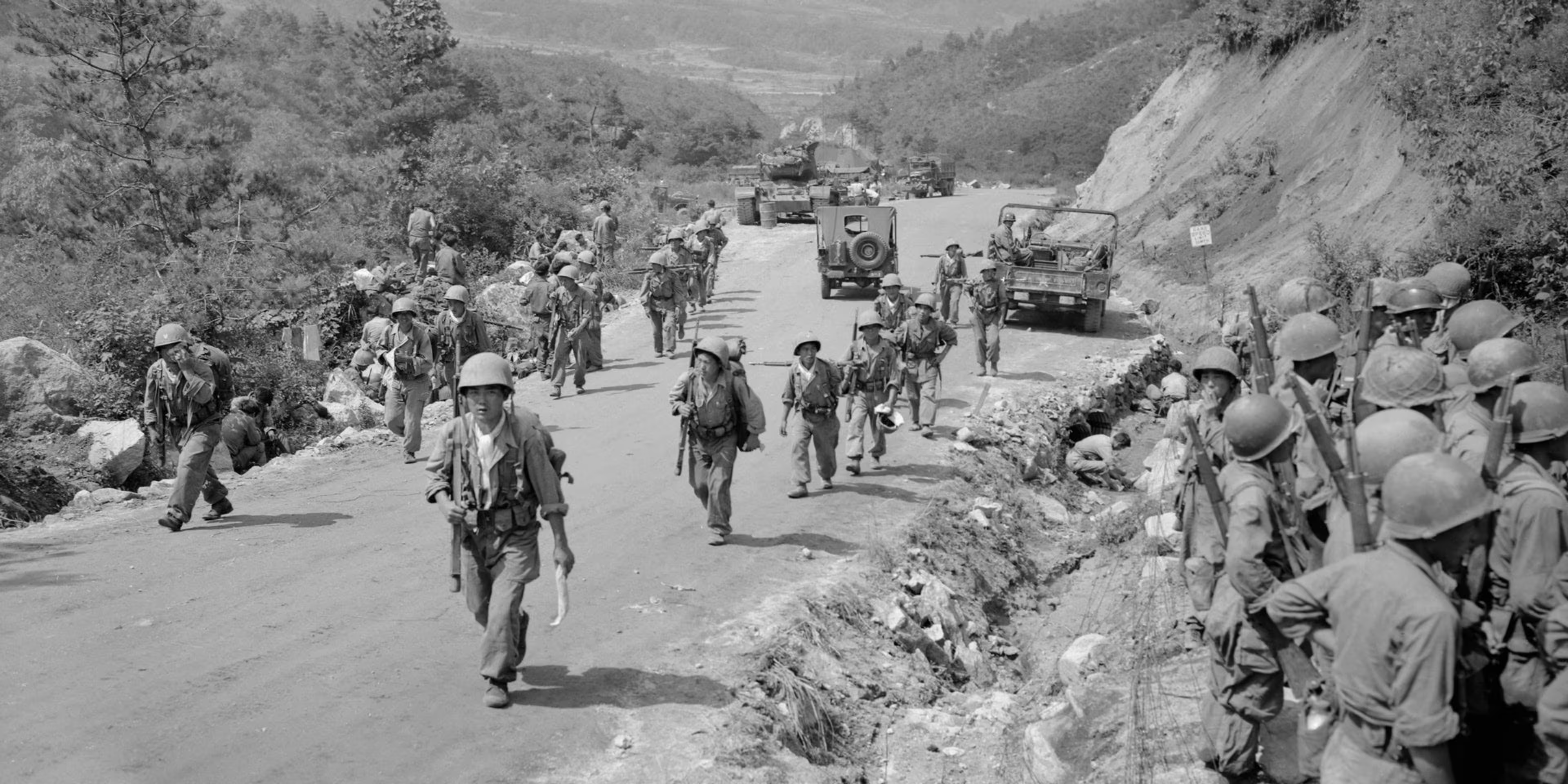
Photo from Getty Images.
The memory of the Korean War still haunts both Koreas. Three million Koreans died in the conflict, the peninsula’s division was hardened, and a tense geopolitical arrangement was locked into place. Ever since, successive South Korean governments have looked to the United States for protection against the hostile North Korean regimes. The U.S. and South Korea signed the Mutual Defense Treaty in 1953 designed to leverage the military might of the United States to protect against northern attack. The playing-board changed in 2006, however, when North Korea tested a nuclear bomb, and again in 2017, when the Kim regime obtained intercontinental ballistic missiles. North Korea could now impose catastrophic damage on hostile states, forcing the United States to accept painful levels of risk. A terrifying question became more real: if full-scale war broke out, would the United States accept the possible annihilation of Los Angeles to save Seoul?
For decades, the United States’ rationale for deterring North Korea was one of geopolitics and security. In 2026, the argument has become increasingly economic. As the artificial intelligence boom roars ahead in the mainland U.S., South Korea, which captures approximately 83% of the global memory market, is becoming indispensable. Memory is the complement to logic chips as the wheels are to a bike; AI cannot run without it. AI chips require streaming model weights from memory to the logic core to decode the next token, and high-bandwidth memory (HBM) makes AI inference efficient. To achieve large-scale HBM production, the two South Korean companies, Samsung and SK hynix, utilize some of the most complex manufacturing technologies on Earth. America’s Micron keeps up, China’s CXMT is significantly behind, and the rest of the world is not competing at all. The Korean memory companies collect hundreds of billions of dollars in revenue, annualized. Due to a majority of global memory being produced in South Korea, and the incredible technological difficulty in replicating memory manufacturing, Korean memory is increasingly irreplaceable for the United States.
South Korea’s government, under President Lee Jae-Myung, has acted decisively on this windfall. In June 2026, his administration announced an 800-trillion-won (approx. 520 billion USD) plan to leverage Samsung and SK Hynix to build new fabrication plants and increase investments in Korea. The purpose was to cement South Korea’s memory chip leadership. One month later, South Korea hosted a gathering of the leading figures in artificial intelligence and semiconductors in San Francisco, where President Lee remarked his goal was to make Korea an “irreplaceable” country. President Lee’s push for his nation’s indispensability could therefore be motivated by a desire to create a “memory shield.” The “memory shield” is an analogue to Taiwan’s “silicon shield,” an established theory that states that Taiwan’s irreplaceability in logic chips creates an incentive for the U.S. to defend the island nation. Similarly, South Korea’s irreplaceability in memory chips creates an incentive for the U.S. to defend Korea. However, the “memory shield” could increase security while also giving North Korea a more valuable economic vulnerability to threaten.
As South Korea becomes increasingly indispensable, the potential payoff for the Kim regime could increase. If North Korea could threaten South Korean memory manufacturing or exports, the Hermit Kingdom could gain leverage over the global memory market. A reduction of memory exports from South Korea would immediately cause a supply crisis as the only other company in the world that could supply AI memory is the American company Micron. However, Micron’s memory production alone cannot cover the ravenous demand for memory from American technology companies. Such a crisis would threaten America’s economy and technological leadership.
The potential danger can be seen through two channels: hybrid warfare and shipping attacks. Concerningly, each already has a playbook being established by Russia and Iran.
The first, hybrid warfare, entails low-intensity attacks on South Korean infrastructure below the level of a military operation. These attacks could include “accidental” drone or missile incidents, cyberattacks, or sabotage. The South Korean memory industry is incredibly vulnerable to such attacks. Memory fabs are huge and fragile structures that can cost over a hundred billion dollars to build. Additionally, all existing Korean memory fabs are located relatively close to the North Korean border (Appendix). A single stray drone or act of sabotage might shut down a fab for months. A precedent already exists: North Korea’s informal ally Russia has been escalating hybrid warfare against Europe in the past months. In August 2026, a Russian explosives-laden drone failed to detonate at Leipzig Airport in Germany, and a Russian plot to commit arson at a building belonging to an Estonian defense firm was foiled. Similar low-level attacks on Korean memory plants could threaten their operation.
The second, shipping attacks, entails low-intensity attacks on South Korean commercial shipping and flights. Such attacks could include sabotage or drone strikes on airports and ports, or incidents aimed at merchant vessels or airplanes. The Port of Busan is ranked 4th globally in competitiveness by the DNV, a classification society, and is the lifeblood of the Korean economy. Incheon International Airport, where a large portion of Korean memory is exported from, is vulnerable to even small disruptions. North Korea has previously been condemned for interfering with Global Navigation Satellite System (GNSS) signals in civil aviation. Again, a precedent exists: Iran has been attacking cargo ships in its war with the U.S., which increased commercial shipping risk. Oil tankers have been escorted by the U.S. Navy, shipping and insurance costs have spiked, and global oil prices are at a multi-year high. A moderate degree of kinetic attack has created outsized risk, and a similar dynamic could play out in the waters and air surrounding South Korea.
North Korea has a shield it can hide behind after conducting increasingly provocative actions. North Korea’s nuclear arsenal gives it the ability to threaten far greater damage to South Korea or even the United States if the two countries retaliate. This dynamic allows North Korea to conduct low-level attacks that cause ever greater amounts of damage on the South Korean memory industry. At the same time, the U.S. gains a greater economic incentive to protect South Korea. It is hard to see how this trend would not be incendiary.
Will the “memory shield” therefore lead to greater security on the Korean peninsula or greater danger? The status quo could point towards greater danger. Despite stronger American interests on the peninsula, such low-level attacks have room to cause damage without triggering a formal war due to attribution difficulty or the nuclear shield. The Kim regime could use such attacks or the threat of attacks to extract concessions from South Korea or the US who would suffer immediate economic costs while uncertainty regarding retaliation reigns. The best bet to flip the dynamic is therefore to make low-level attacks either more physically difficult or geopolitically risky for the Kim regime.
The most obvious solution is to harden protection at airports, ports, and memory fabs. Air defense, from ballistic missile interceptors to interceptor drones, could be installed at the sites to offer protection. Even a few air defense systems would offer meaningful protection to infrastructure far more expensive than themselves. Geopolitically, the U.S. could preemptively declare that such attacks would be unacceptable and back it up by providing American systems and American personnel as point protection to “tie its hands.” Such a policy could strengthen deterrence; the destruction of American systems or the killing of American troops would force the U.S. to respond more forcefully. In theory, the Kim regime would be less enthusiastic in conducting attacks if it knew the U.S. would be forced to respond harshly.
The memory of South Korea fuels the American AI economy; memory chips deepen the American security commitment to the peninsula. The memory of the Korean War sees North Korea a hostile, isolated, and nuclear nation, ready to pounce on any opportunity. The “memory shield” entangles all three nations in an increasingly strategic and tense dance with critical consequences for Seoul, Washington, and the future of artificial intelligence.
Appendix 1

•••
Taeho Lee is a sophomore majoring in Political Science, Security, and Technology. He is interested in AI, semiconductors, nat-sec, and defense, and has prior experience in OSINT, quantitative research, and political advocacy.


Leave a Reply