
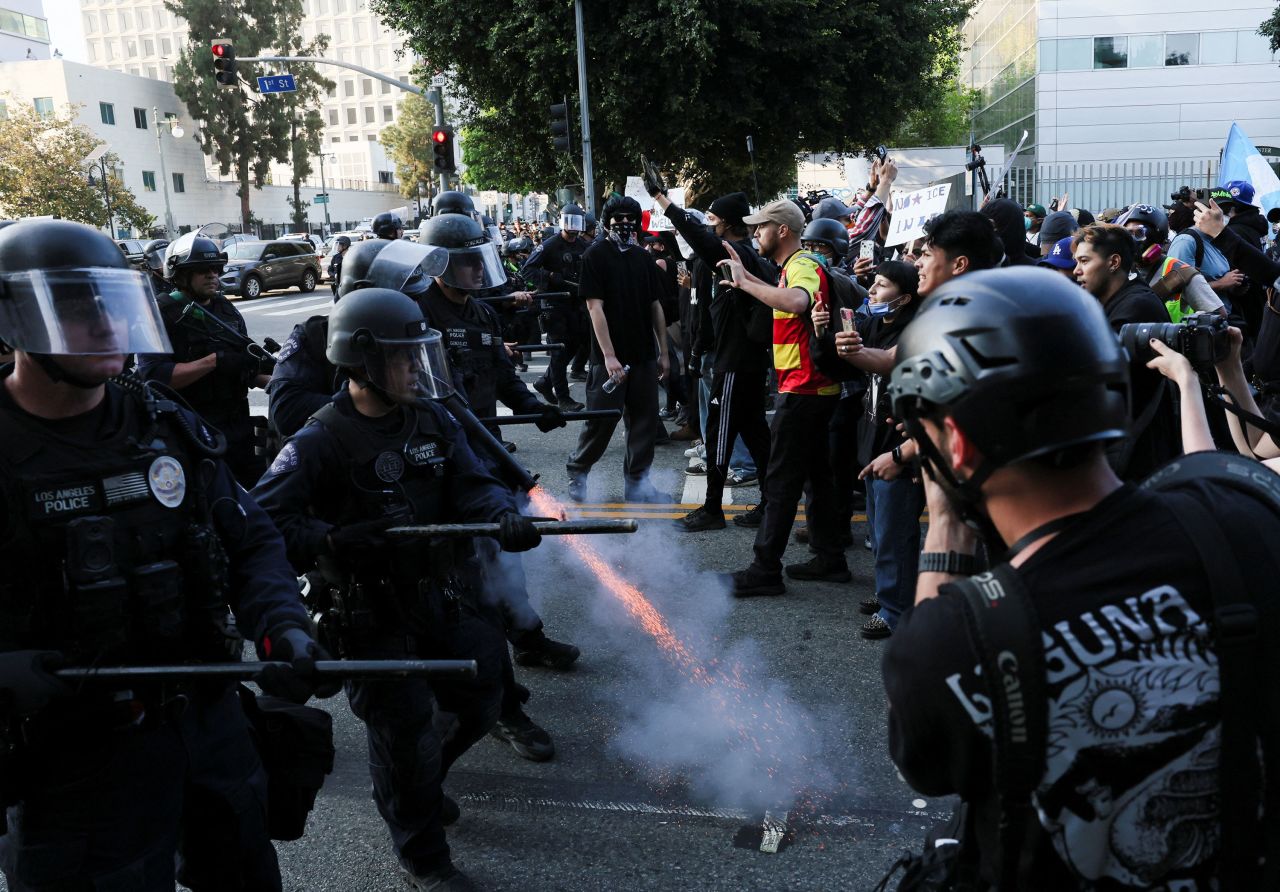
Photo by Leah Millis/Reuters
Earlier this summer, outrage erupted in Los Angeles over ICE raids on immigrant communities. Part of the protests emerged over the violent conduct and military-style apparel donned by the federal agents. Similar concerns were expressed about the National Guardsmen, who also appeared to be dressed for combat.
Both groups were spotted adorning tactical gear, helmets, and military-style rifles. ICE agents were even seen traveling in military-like tanks and deploying flash-bang grenades, which have been known to cause severe injuries, on civilians. Commenting on the apparel and equipment, the New York Times called it “an extraordinary show of force.” The Guardian also labeled some of ICE’s conduct as “an extraordinary show of force,” echoing the language of the New York Times.
However, their apparel, equipment, and conduct are far less than extraordinary. In fact, compared to other civilian law enforcement, this type of militarization is really quite ordinary.
Since the 1960s, civilian law enforcement in the US has grown ever closer to a military-style force. In 1967, anti-Vietnam War protests prompted the Los Angeles Police Department to develop the first SWAT (Special Weapons and Tactics) team in the nation—a tactical police unit meant for high-risk situations.
Under President Richard Nixon, there was a significant expansion in funds available to use for the development of SWAT programs. Civilian law enforcement agencies saw substantially more funds available to purchase technology, equipment, and training with. As a result, cities all over the nation began developing their own SWAT teams.
Furthermore, between the late 1980s and early 2000s, many new federal programs and grants were established to provide state and local law enforcement with new technology and equipment—primarily military equipment. The Department of Justice instituted their Justice Assistance Grant (JAG) Program, the Department of Defense developed their 1033 program, and the Department of Homeland Security formed their own grant program.
Through the 1033 program, over $7 billion worth of military equipment has been transferred to civilian law enforcement agencies to date—some of which was used in combat against foreign enemies before being acquired by law enforcement agencies. Alongside those funds, the Department of Homeland Security has provided over $34 billion in grants, much of which has been used to purchase new military equipment.
These funds have touched almost every part of the the nation. Between 2006 and 2013, 80 percent of counties received transfers of military weapons.

Source: Urban Institute
Some examples of the type of equipment acquired through the 1033 program include automatic rifles, tactical gear, grenade launchers, bayonets, tank-like vehicles, airplanes, helicopters, and more. Department of Homeland Security grants have allowed civilian law enforcement to purchase much of the same equipment along with tanks, surveillance drones, and machine guns.
As a result of these programs and others, almost 80 percent of towns in the US with a population over 25,000 had developed a SWAT team by 1995. Moreover, by the mid-2000s, SWAT teams began appearing in towns with a population less than 5,000.
Many of these programs were created with the stated purpose of fighting terrorism, and civilian law enforcement agencies have justified their need for military equipment by suggesting that it is crucial to thwart terrorist activity.
However, rarely are SWAT teams used for that intended purpose. In fact, an ACLU report from 2014 found that SWAT teams were only deployed to handle hostage, barricade, or active shooter scenarios 7 percent of the time. Likewise, a police chief for the San Diego Police Department has been reported saying that SWAT teams are “more useful for traditional crime busting than counter terrorism.”
Despite these comments from the San Diego police chief, SWAT teams and other militarized officers are not the best equipped to handle “traditional crime busting,” and their presence is often unnecessary. In many cases, SWAT teams have escalated situations far beyond what was necessary. Similar to ICE in recent months, SWAT teams have used military-style rifles, tactical gear, flashbang grenades, armed vehicles, and more on civilians, which has had deadly effects.
Comprising the vast majority of their deployments, at 79 percent, SWAT teams are often used to execute search warrants. In many instances, they have unnecessarily injured and killed people, even if they were unarmed, while serving warrants. One man was shot and killed while laying facedown on the floor with his arms above his head when an officer’s weapons fired. In another incident, SWAT broke down a woman’s door and killed her while she was holding her 14-month-old child, despite being unarmed.
When serving warrants, it is also not uncommon for SWAT teams to use flashbang grenades—the same type of weapon federal agents have used against civilians recently. Not only is their use often excessive, but it can also cause severe injuries. In 2014, while serving a search warrant, a flashbang grenade was thrown into the crib of a 19-month-old baby, causing the child to be placed in a medically induced coma, due to the severity of his injuries.
Alternatively, law enforcement officers are also put in danger because of this type of conduct. There have been many instances where civilians have mistaken SWAT teams for armed burglars during raids. In response, people have opened fire, resulting in shootouts that have caused both civilian and law enforcement fatalities.
These are not isolated events. Rather, they are part of a concerning pattern that has been confirmed through statistical analysis. A 2021 study found that militarization has had detrimental effects on both civilians and law enforcement. Since 2010, civilian deaths caused by law enforcement have increased by 8.4 percent because of militarization, which corresponds to about 64 additional deaths each year. Likewise, officer assaults have increased by 15.9 percent, injuries by 12.8 percent, and deaths by 5.3 percent.
Given the danger militarization has posed for civilians and officers, new policy and oversight at all levels of government are crucial to reverse this trend.
At the federal level, transfer and grant programs that have allowed local law enforcement agencies to attain billions of dollars worth of military equipment must be clawed back. Moreover, a removal of some of the provisions within the grant programs is also necessary. For example, the Department of Defense’s 1033 program requires law enforcement agencies to use their newly acquired equipment within a year of receiving it, encouraging its usage even when it may not be necessary. Provisions, such as this one, must be removed.
Likewise, state and local governments also have a role to play in limiting the use of militarized force on civilians. State and local governments must implement stricter guidelines, outlining when SWAT deployment is appropriate. Furthermore, they must impose new regulations that require greater documentation of the force used, deaths or injuries that occurred, and other pertinent information about SWAT raids for proper oversight.
Even if the growing use of military equipment is no longer extraordinary, it remains deeply problematic. The use of force employed by ICE and other federal agents in recent months as well as by local law enforcement over the last few decades should not be routine. It endangers both officers and the public, making a sufficient remedy crucial before more lives are claimed.
Staten Rector is the President of the Policy and Law Review. He is a junior, studying Economics and Politics as well as Ethics, History, and Public Policy



Leave a Reply