
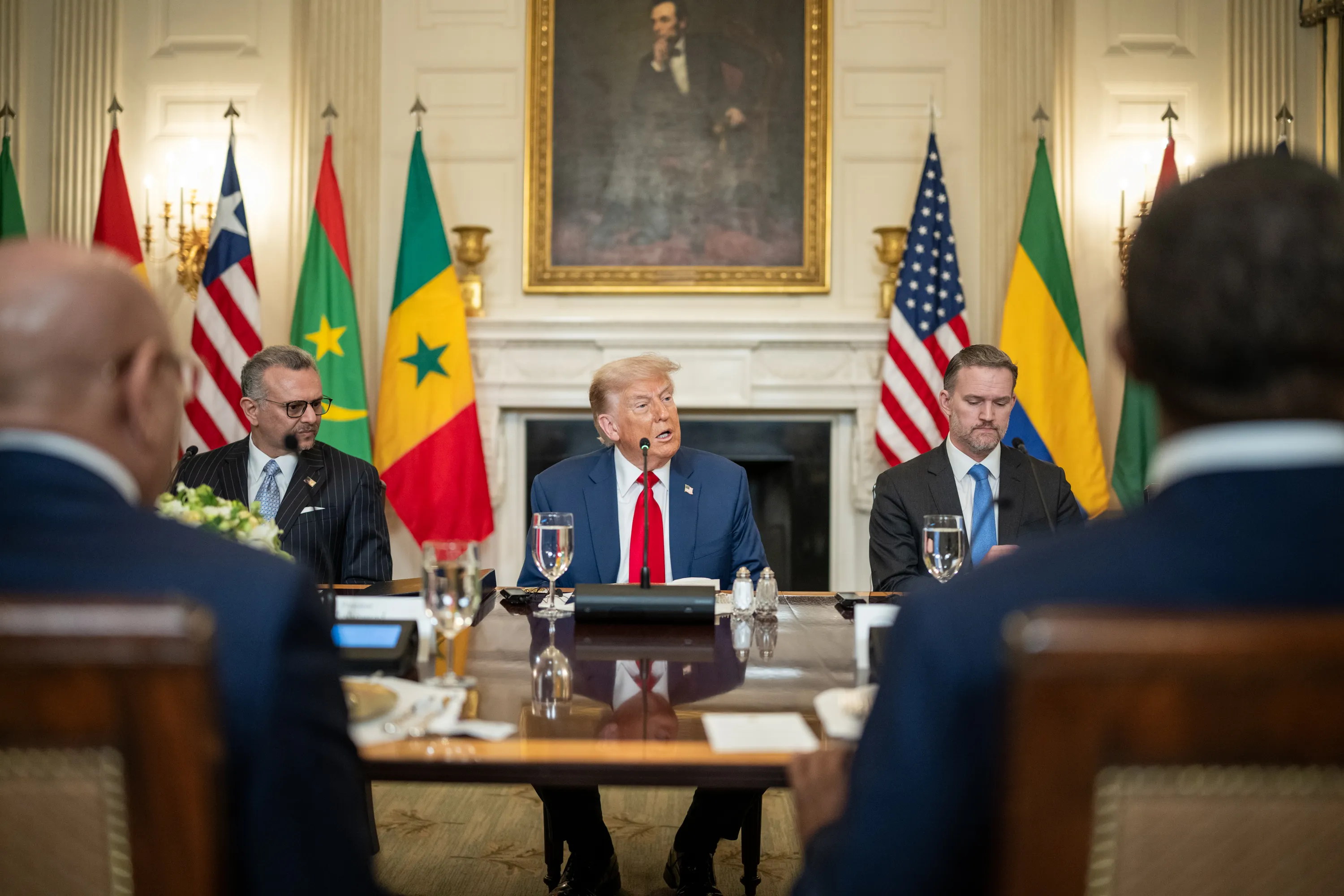
Photo from The White House Gallery.
Since the Trump Administration assumed office in January, noticeably absent from the White House is any mention of a conclusive African policy agenda. It appears the United States is willing to disregard the continent entirely. For any who closely follows African affairs, the admin’s neglect in prioritizing an African strategy confirms a declining interest in the continent. Africa is often mischaracterized in Washington by those who overlook its strategic importance, especially as its economic evolution will soon shape the balance between liberal and illiberal powers. In doing so, the US risks abandoning its position as a leading global trade partner to actors that fail to prioritize Africa’s economic sovereignty.
The largest shock to US-African Relations occurred in July, when the Department of Government Efficiency (DOGE) effectively dissolved the US Agency for International Development (USAID). The agency was the largest foreign aid program in the world; it allocated up to $12.7 billion in assistance to sub-Saharan Africa annually. The critical role that USAID played in Africa cannot be overstated; it supported healthcare systems, alleviated food security, and promoted responsible governance. When Trump administration officials were pressed on the perilous cuts to USAID made by DOGE, several expressed contentious views on Africa’s perceived reliance on foreign aid and humanitarian relief. Secretary of State Marco Rubio in particular, insisted the US would abandon “a charity-based model” regarding future assistance to the continent.
The rebuffs on Africa’s financial dependency have left many wondering, what exactly is the future of US-Africa relations? If the era of US-led development assistance is now over, then, a coherent economic framework focused on building sustainable partnerships should result in its place. Global competitors have already secured long-term military agreements with African partners (i.e. Russia’s naval base in Sudan, China’s Global Security Initiative). Leaders are embracing a range of geopolitical alignments that exclude the US altogether.
Despite these shifts, there have been no clear goals or policy initiatives on Africa laid out by this administration to counter their military expansion, or to mitigate the impacts caused by the aid cuts. Instead, all the Trump Administration seems to be offering are empty assurances.
The African Affairs Bureau asserts its 3 main objectives in Sub-Saharan Africa are to: support the region’s self-reliance, establish mutually beneficial trade relationships, and protect the US from security threats. However, with the exception of the Critical Minerals for Security Deal (part of the Democratic Republic of the Congo-Rwanda Peace agreement), the administration has yet to sign any notable trade deals with African leaders. Shortly after USAID cuts took place in July, President Trump hosted a business lunch at the White House with five West African nations to discuss similar mineral deals. The luncheon was ultimately unproductive, dominated by bad publicity rather than any substantive trade talks. Although, diplomatic engagement from the White House could help reverse the trend of missed trade opportunities.
Washington’s insufficient leadership on African affairs is also worth noting. In April 2025, Massad Boulous, a Lebanese-born billionaire and father-in-law to Tiffany Trump, was appointed Senior White House Advisor on African Affairs, and is by default, the admin’s top Africa policy official. Boulous also serves as Trump’s Middle East Advisor, which makes his work on Africa less of a chief priority. Since Assistant Secretary Troy Fitrell’s departure in July, the admin has not yet appointed an Assistant Secretary of State for African Affairs. This leadership vacuum signals Washington’s lack of seriousness when pursuing a new Africa strategy.
Between cessation of aid and high tariffs, foreign policymakers have shown their discontent with USAID’s expenditures through punitive economic measures, but Africa has never sought perpetual handouts. In addition to the five African leaders that lunched with the president, other countries such as Zimbabwe, South Africa, and Madagascar have also expressed a desire for dealmaking, and improving trade relations with the United States. These nations have demonstrated significant GDP growth in 2025. For Washington to disregard the economic potential that Africa has to provide as one of the fastest growing markets in the world today is shortsighted.
Scholars have noted that Africa’s attraction to China is also partly due to the exasperation that many leaders demonstrate with the seemingly selective and coercive implementation of Western Liberal-International-Order ideals. As exemplified by the recent SCO summit, geopolitics are slowly moving away from the LIO’s predominance. While it remains clear that upholding liberal democratic values in Africa is no longer a priority for the US, the current administration could substantiate its pivot to trade with tangible policy proposals.
As the EU prepares to face its own reckoning with Russia, combined with Iran’s firm and unyielding presence in the Middle East, Africa is one of the few fronts in which the US can fight to regain its own influence. If the current administration fails in adopting a clear approach to address the obvious rift in US-Africa relations, the path to a geopolitically weakened United States will only grow wider. The governance and security challenges that Africa is currently plagued with may have left many mistaken, but Africa still has a lot left to lose, and even more to offer.
Are foreign policymakers in Washington ready to accept a diminished role in Africa, even if this transformation ultimately results in a nonpolarity that decenters the U.S. and its interests?


Leave a Reply