
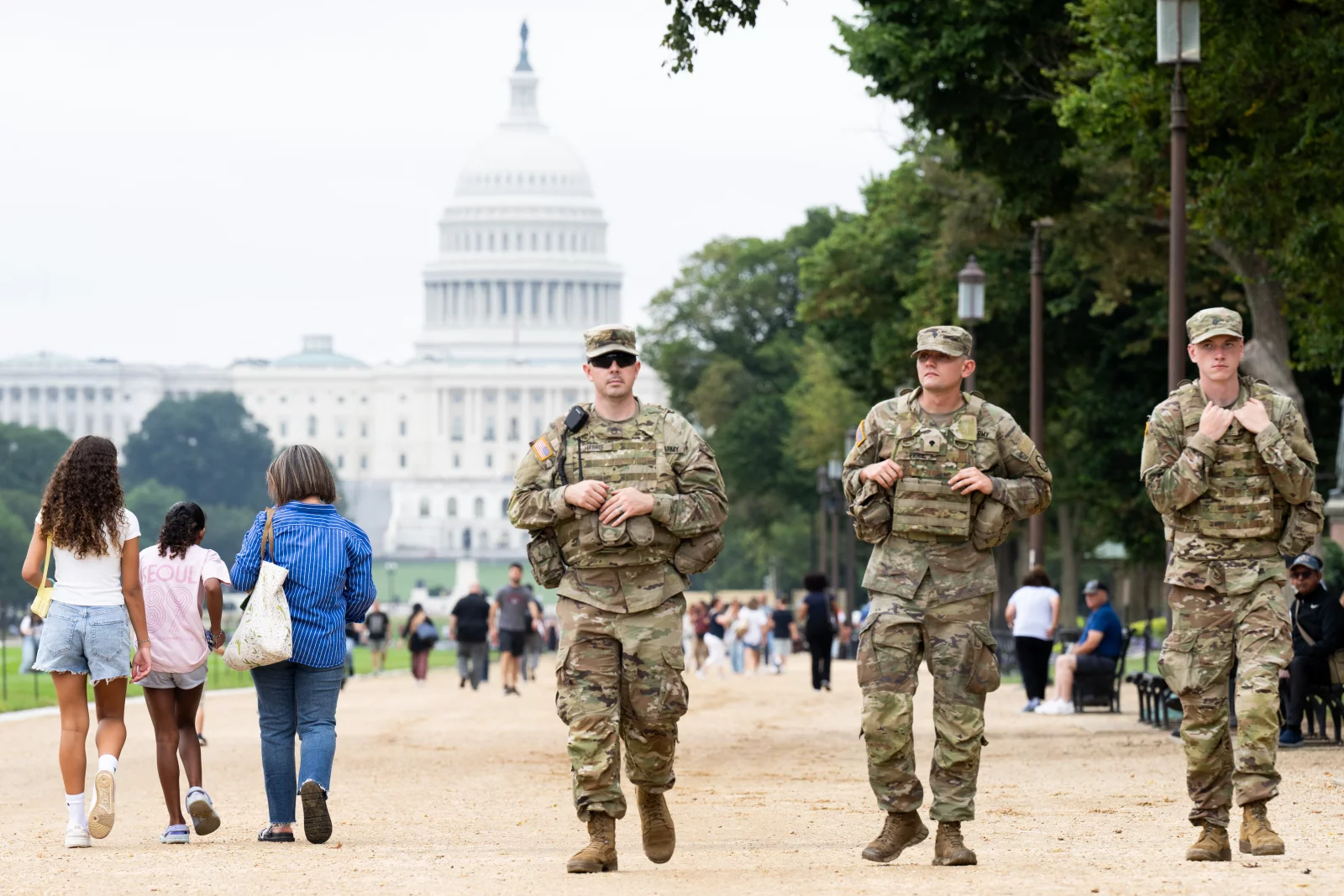
Photo from Saul Loeb/AFB.
This past month President Donald Trump deployed members of the National Guard to Washington, DC in order to aid local law enforcement and decrease crime. Trump announced that under the District of Columbia Home Rule Act he would place federal control over the police department.
This Act grants a limited amount of self-governance to Washington, DC, by allowing residents to elect a mayor and city council, while simultaneously preserving certain powers for the federal government. Notably, this act allows for the president to exercise authority of the city’s police force in the case of an emergency. This provision is intended for rare situations where local authorities are unable to maintain order or are facing large crises, and need greater assistance to control the situation.
The U.S. National Guard is a military force that conducts both state and federal duties. Generally, they are under the authority of governors, but presidents may assume control during national emergencies or when they are needed for federal operations. Although it is rare for a president to take command, it is not unheard of. In June 2025, President Trump deployed National Guard troops to California—without the consent of Governor Gavin Newsom—to protect personnel and property during the protests occurring in LA. Prior to the deployment of the National Guard to LA, a president has not bypassed the approval of a state government since 1965 when President Lyndon B. Johnson sent troops to the state of Alabama to protect civil rights workers.
In regards to the current deployment in the District of Columbia, the Trump administration claimed that federal intervention is needed to counteract violent crime. In 2025, President Trump characterized the city as experiencing a surge in violent crime, which laid the foundation for his use of emergency powers under the Home Rule Act and the deployment of National Guard troops to assist local police. President Trump’s efforts to reduce crime have been successful, with BBC reporting that from August 12 to 26 there has been a 23 percent decrease in violent crimes compared to the previous two weeks. In addition, CNN detailed that the first day the Trump Administration took control of the Metropolitan Police Department violent crimes dropped by approximately 17 percent and property crimes dipped by about 19 percent compared to the week before. These changes likely resulted from the enhanced law enforcement presence, who assisted local police with arrests, searches, and warrant executions. This federal support was particularly evident in areas like the H Street corridor.
Two weeks ago, the full Committee on Oversight and Government Reform discussed the “Oversight of the District of Columbia.” They focused on the advantages and disadvantages of the deployment of the National Guard as well as alternative measures to combat crime in DC. While members from both parties have expressed their desire to increase public safety across the nation, there is a lack of consensus on how best to address this challenge.
On one side of the debate, Republican Congressmen highlighted the benefits of deploying the National Guard. Chairman James Comer (R-KY), Congressman Paul Gosar (R-AZ), Jim Jordan (R-OH), and Scott Perry (R-PA) all expressed their support for the deployment of troops in the District. Their individual arguments all revolved around the National Guard’s assistance in lowering crime rates in the area. In addition, Congressman Gosar mentioned his support for H.R.5183 – District of Columbia Home Rule Improvement Act. This Act aims to amend the District of Columbia Home Rule Act to make sure Congress has a consistent 60-day period to review DC laws and clarify how Congress can quickly reject parts of those laws, executive orders, or regulations.
On the other hand, Democratic members argued against the continued presence of the National Guard troops in the District. Ranking member Robert Garcia (D-CA), Congressman Stephen Lynch (D-MA), Congressman Raja Krishamoorthi (D-IL), and Congresswoman Summer Lee (D-PA) all showcased their support for removing the National Guard from the District. Their claims revolved around the possible decrease in trust in the capabilities of local law enforcement, the high expenses of keeping the troops in the District, and crime rates showing a downward trend before the troops were deployed.
Shifting attention away from military presence, some congressmen proposed alternative strategies focused on addressing the root causes of crime to lower crime rates in the District of Columbia. Congressman Glenn Grothman (R-WI) focused on methods that keep the father in the home to strengthen family bonds. Congresswoman Virginia Foxx (R-NC) focused on the need to improve the education system. Mr. Jackson Jr. (Survivor of gun violence) highlighted the need for greater funding for local programs.
The situation in Washington, DC highlights the complexity of maintaining a public safety wheel respecting local governance. The deployment of the National Guard and federal oversight has sparked debate that reflects different views on the best approach to crime reduction–whether through increased security measures or addressing underlying social issues. Both sides emphasize the importance of protecting residents, but they differ on methods and properties. As discussions continue, a long-term solution will require careful consideration of public safety, community trust, and the unique political status of the District.




Leave a Reply